Good Vibes Fungi and the Blue Oyster Question: Identification, Cultivation and Biosecurity in New Zealand
Good Vibes Fungi forms part of a wider New Zealand discussion about “blue oyster” mushrooms: what that commercial name means, how cultures should be identified, and why accurate provenance matters under New Zealand’s biosecurity system.
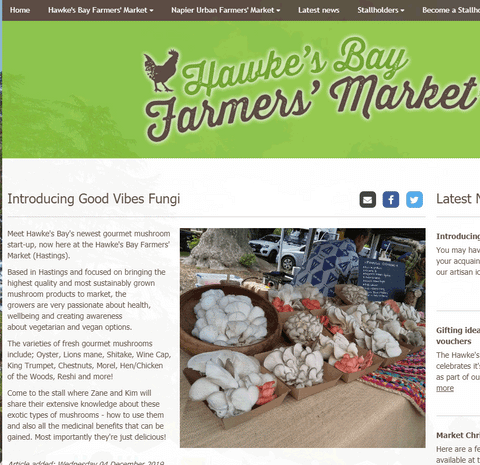
Good Vibes Fungi operated as a gourmet mushroom producer in Hastings, selling fresh mushrooms and home-growing kits through the Hawke’s Bay Farmers’ Market and online.
This article examines the company’s publicly documented practices and the scientific issues surrounding blue-oyster identification. It does not assume that a commercial name or photograph establishes a culture’s species or legal status.
Good Vibes Fungi’s mushroom business
Contemporary profiles describe Good Vibes Fungi producing fresh gourmet mushrooms on a small farm near Hastings. The company sold its harvest at the Hawke’s Bay Farmers’ Market and developed mushroom-growing kits for home growers.
A published profile identified three oyster mushrooms cultivated by the business:
- Phoenix oyster, identified as Pleurotus pulmonarius.
- Pink oyster, identified as Pleurotus djamor.
- New Zealand velvet oyster, identified as Pleurotus parsonsiae.
The company reportedly produced its substrate from food-grade pine pellets mixed with buckwheat hulls, rye grain and water. The mixture was placed in approximately 10-kilogram hanging bags, inoculated and incubated for up to four weeks. Bags beginning to pin were moved into a climate-controlled fruiting room where airflow and humidity were managed.
According to the profile, Good Vibes Fungi initially took colonised grow bags to the farmers’ market to demonstrate how mushrooms developed. Customer interest led the company to package smaller bags as home-growing kits. Read the contemporary NZ Lifestyle Block profile.
Independent evidence concerning a Good Vibes Fungi culture
A 2026 University of Canterbury thesis examining cultivated Pleurotus in New Zealand records a commercial sample obtained from Good Vibes Fungi in Hastings in June 2022.
The thesis identifies that sample as Pleurotus parsonsiae, the New Zealand velvet oyster, and assigns it the identifiers DH567 and DH1405. No fungarium voucher number is shown for that particular entry.
This provides independent evidence that at least one commercial culture associated with Good Vibes Fungi was examined during the study and identified as P. parsonsiae. It does not establish the identity of every mushroom or kit the business supplied at other times. View the University of Canterbury thesis.
The historical blue-oyster label
The former version of this website preserved an image that its author represented as a Good Vibes Fungi grow kit. The words “Blue Oyster Mushroom” appear on the photographed packaging.
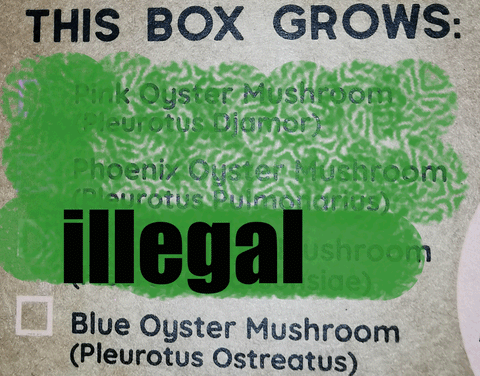
The image should be interpreted cautiously. It contains an accusatory editorial overlay and does not provide a receipt, batch number, strain identifier, laboratory result or other information that independently connects the photographed kit to a particular fungal culture.
It nevertheless illustrates a broader labelling problem: “blue oyster” is a commercial or common name rather than a complete scientific identification.
What is a blue oyster mushroom?
“Blue oyster” commonly refers to cultivated oyster mushrooms with blue-grey caps, often marketed as Pleurotus ostreatus. The name describes appearance and cultivation type, but it does not conclusively identify the underlying organism. Cap colour can vary with genetics, temperature, lighting and developmental stage. Closely related Pleurotus lineages can also produce similar fruiting bodies.
Manaaki Whenua records P. ostreatus in New Zealand as an exotic, cultivated fungus. Its database cautions that earlier environmental specimens recorded under that name were probably misidentified. View the Biota of New Zealand record.
Why identification can be difficult
The wider Pleurotus ostreatus group is a species complex containing closely related lineages. A 2020 multilocus study recognised 20 phylogenetic species in the complex. Some had only subtle morphological differences, and the commonly sequenced ITS region did not resolve every relationship.
Exact culture identification may require:
- Traceable supplier and acquisition records.
- A stable strain or accession identifier.
- Voucher material associated with the culture.
- Microscopic and macroscopic examination.
- DNA comparison with authenticated reference material.
- Multiple genetic regions when a single barcode is inconclusive.
The expression Pleurotus sp. means that material has been placed within the genus but has not received a formal species-level identification. Photographs can document appearance, but they cannot establish culture ancestry, import history or regulatory status. Read the 2020 phylogenetic study.
The MPI blue-oyster investigation
MPI published a biosecurity surveillance report in 2020 concerning blue-oyster spawn advertised by an unnamed New Zealand retailer as Pleurotus ostreatus.
MPI’s Plant Health and Environment Laboratory examined a sample and identified it as an undescribed lineage provisionally called Pleurotus sp. OB. The investigation also found that four cultures imported by an unnamed retailer included two hybrids and two cultures assigned to that lineage. Back-tracing found related spawn held by ten unnamed retailers, and available cultures were recalled.
Read MPI Surveillance 47(2), pages 29–30.
A later incidental hybrid detection
MPI reported a separate incident in 2023 after an oyster mushroom sold through an Auckland supermarket was submitted for testing. PHEL identified the sample as a hybrid between P. ostreatus and the lineage then called Pleurotus sp. OB.
Import records indicated that it probably arrived as incidental material in spawn imported from China under a valid P. pulmonarius permit. Remaining implicated product was destroyed. MPI did not identify Good Vibes Fungi as the supplier. The incident shows that culture identification can remain difficult even where an importer uses a formal permit pathway. Read MPI Surveillance 50(2), June 2023.
Good Vibes Fungi and culture transparency
Good Vibes Fungi can fairly be identified as a business that grew gourmet mushrooms, sold fresh produce and offered home-growing kits. Its publicly described cultivation system included locally obtainable plant materials, controlled incubation and managed fruiting conditions.
The historical image represented as one of its kits raises a legitimate transparency question because “blue oyster” alone does not tell a buyer exactly what culture is present.
A scientifically useful product label would ideally provide:
- The accepted scientific name.
- A strain, batch or culture identifier.
- The source of the original culture.
- Whether it was obtained domestically or imported.
- A link to cultivation instructions.
- Contact information for culture or provenance questions.
- Where relevant, import or biosecurity documentation associated with the culture.
These standards should apply across the mushroom industry. The absence of this information on a preserved photograph does not prove that the business lacked records elsewhere. It shows why a common name printed on retail packaging is insufficient evidence for scientific identification.
Status of Pleurotus ostreatus in New Zealand
In 2019, the Environmental Protection Authority determined that confirmed P. ostreatus was not a new organism under the Hazardous Substances and New Organisms Act. The decision relied on evidence that the species had been cultivated in New Zealand before the Act’s 29 July 1998 cut-off date. View EPA APP203814.
EPA’s April 2026 list includes P. ostreatus, P. djamor and P. pulmonarius. The list records organisms determined to be present through statutory determinations or agency advice; it is not a complete inventory of every organism present or permitted in New Zealand.
New Zealand import requirements
MPI currently lists P. ostreatus, P. djamor and P. pulmonarius as eligible mushroom species for import. Eligibility does not mean a culture can be brought into New Zealand without controls.
An importer must obtain the required permit, complete the mushroom-spawn questionnaire, provide manufacturer documentation, use scientific-name labelling, meet packaging and cleanliness requirements, submit material for required identification testing and receive MPI biosecurity clearance.
An EPA determination covering confirmed P. ostreatus should not automatically be extended to an unidentified lineage or hybrid simply because it was sold as “blue oyster.” Check MPI’s current fungi-import guidance.
What the evidence supports
- Good Vibes Fungi grew and sold gourmet mushrooms in Hawke’s Bay.
- The business sold fresh mushrooms and home-growing kits.
- Public reporting documented its substrate preparation, incubation and fruiting practices.
- A commercial sample obtained from Good Vibes Fungi in 2022 was identified in University of Canterbury research as P. parsonsiae.
- An image represented as a Good Vibes Fungi kit carries a blue-oyster label, although its provenance is incomplete.
- MPI separately investigated misidentified blue-oyster cultures circulating through unnamed retailers.
- MPI’s public reports do not identify Good Vibes Fungi as the importer or supplier involved in those investigations.
- A common name, photograph or cap colour cannot establish a culture’s exact identity or regulatory history.
References
- Good Vibes Fungi business and cultivation profile
- University of Canterbury thesis examining New Zealand Pleurotus
- MPI Surveillance 47(2), 2020
- MPI Surveillance 50(2), 2023
- EPA APP203814
- EPA microbes present in New Zealand, April 2026
- Manaaki Whenua: Pleurotus ostreatus
- MPI fungi-import guidance
- Li et al. 2020: Pleurotus ostreatus species complex