Did Sporeshift Bring Black King Oyster into New Zealand?
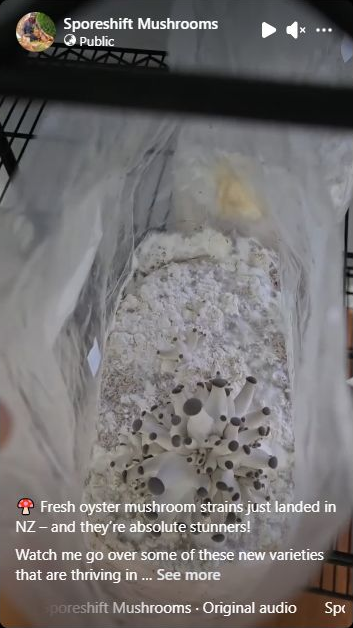
Sporeshift Mushrooms publicly promoted Black King among oyster strains it said had “just landed in NZ.” That wording raises a legitimate question about provenance and regulatory clearance, but the public post does not identify the importer, overseas source, scientific name, permit or border-clearance record.
Claim examined
“Black King Oyster was brought into New Zealand by Sporeshift Mushrooms from an unknown source, possibly illegally.”
What Sporeshift publicly said
In a public Facebook reel, Sporeshift Mushrooms used this promotional wording:
“Fresh oyster mushroom strains just landed in NZ”
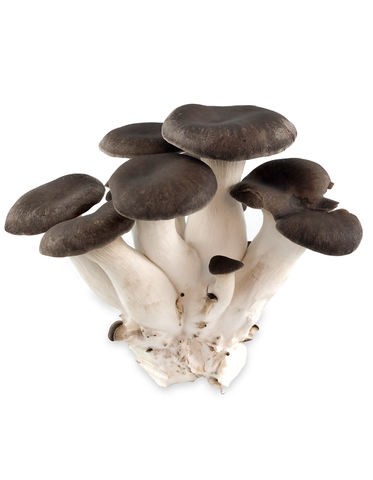
The accompanying caption named “Snow Whites, Blue and Black King” oysters. Read naturally, the post presented Black King as part of a group of newly arrived genetics being grown in Canterbury.
The wording is relevant evidence of how Sporeshift marketed the culture. It is not a shipping document or an MPI clearance record.
What remains unknown
The public reel and caption do not establish:
- who imported the original Black King culture;
- whether Sporeshift imported it or acquired it from another New Zealand holder;
- the country, laboratory or culture collection from which it came;
- its scientific species, parentage or strain number;
- the date and border pathway by which it entered New Zealand;
- the MPI permit and clearance documents, if it was imported; or
- any EPA determination or approval applying to the culture.
For those reasons, “from an unknown source” is a fair description of the public evidence reviewed here. It should not be read as proof that no records exist. Sporeshift may hold records that were not included in the reel.
Why the name Black King matters
Black King is a commercial name rather than a recognised regulatory identity. Overseas sellers use overlapping names such as Black King, Black Pearl King and Black King Oyster for dark-capped cultivated oyster strains.
A peer-reviewed 2023 study describes its commercial Black Pearl King Oyster material as an interspecific hybrid of Pleurotus ostreatus and Pleurotus eryngii. Japan’s official cultivar register also records the HOX 1 cultivar as that cross. Neither source tested or identified Sporeshift’s culture. A shared or similar trade name cannot prove that Sporeshift’s Black King is either of those organisms.
Why an import could be unlawful
MPI currently lists P. ostreatus, P. pulmonarius and P. djamor among mushroom species eligible for import for growing, subject to permits, supplier certification, labelling, testing and border clearance. It does not list P. eryngii.
MPI’s mushroom-spawn consultation records king oyster, P. eryngii, as not present in New Zealand and excluded from import eligibility. The EPA previously made a new-organism determination for P. eryngii. EPA guidance says a viable new organism needs approval before it can be imported, developed, field-tested or released.
If the Black King culture was imported without the approvals and biosecurity steps required for its true scientific identity, that import could have breached New Zealand law. If it was an eligible organism imported under a valid permit and correctly cleared, or a legally established New Zealand culture, the “possibly illegally” concern would not be supported.
No permit, clearance record, enforcement decision or laboratory result reviewed for this article proves which situation applies to Sporeshift’s Black King.
Questions Sporeshift can answer
The uncertainty can be resolved with ordinary culture-provenance records:
- What scientific name and strain identifier are assigned to the Black King culture?
- Is it Black Pearl King or any other P. ostreatus × P. eryngii hybrid?
- Who supplied the original culture, and was that supplier inside or outside New Zealand?
- When and under what scientific identity did it enter New Zealand?
- Which MPI permit, manufacturer’s certificate, testing record and border clearance apply?
- Was an EPA determination or approval obtained for the precise organism?
Sporeshift’s published sourcing position
Sporeshift has separately published a general statement saying its cultures were sourced within New Zealand from established stocks and describing contact with MPI. That is relevant context and weighs against assuming that “just landed” necessarily meant Sporeshift personally imported the cultures. The general statement does not identify the particular Black King culture, its original supplier, scientific identity or regulatory record.
Conclusion
Sporeshift’s own “just landed in NZ” promotion provides a reasonable basis to ask where Black King came from and how it was cleared. The reviewed public material does not disclose that source or pathway.
The available public records do not resolve the source or import history of the culture discussed here. A conclusion about lawful or unlawful importation would require evidence of its scientific identity, the applicable requirements and the actual import or domestic transfer records. Unverified provenance is not evidence that Sporeshift imported Black King illegally.
References
- Sporeshift Mushrooms: public Facebook reel
- Molecules (2023): study using commercial Black Pearl King Oyster described as P. ostreatus × P. eryngii
- Japan MAFF cultivar register: HOX 1
- MPI: steps to importing fungi for growing
- MPI: mushroom-spawn species consultation
- EPA S2604021: Pleurotus eryngii determination
- EPA: about new organisms
- Sporeshift Mushrooms: published statement about culture sourcing