Oak and Spore, Mushroom Sales Records and Culture Verification
A receipt can establish that a product was sold under a particular name. A photograph can record its appearance. Neither establishes the biological identity, ancestry or regulatory history of a living mushroom culture.
Oak and Spore’s commercial practice
Oak and Spore, founded by Tom and Nicky Brain in Canterbury, grows fresh mushrooms and produces spawn and substrate at its indoor farm. The business sells grow kits and spawn and publishes detailed cultivation material for home and commercial growers.
Its public farm history describes a move from a two-car garage to a 200-square-metre facility with two independently controlled fruiting rooms. Oak and Spore currently presents Italian or Phoenix oyster mushrooms as its main oyster crop, alongside pink oyster and shiitake. Read Oak and Spore’s farm description.
Why sales evidence needs careful interpretation
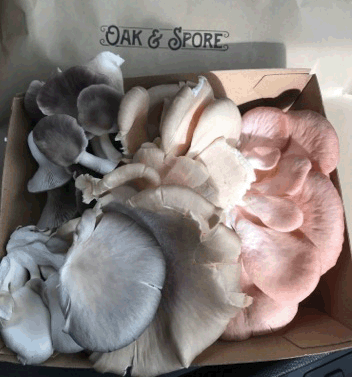
Questions have been raised about whether blue-grey oyster mushrooms sold or shown by New Zealand growers were connected to the misidentified cultures later investigated by MPI. For Oak and Spore, the available photographs show cultivated mushrooms associated with the business, but no public laboratory report reviewed for this article links those mushrooms to MPI’s tested sample.
Independent research involving Oak and Spore
A University of Canterbury thesis examining cultivated Pleurotus in New Zealand records a commercial sample from Oak & Spore, Christchurch, collected in June 2022. The specimen was identified as Pleurotus djamor, with voucher DH1397, DNA identifier DH1406 and PDD accession PDD 124135.
This is independent evidence about one sampled culture. It does not establish the identity of every culture or fruiting body the business handled in earlier or later years, and it is not evidence about the blue-oyster sample examined by MPI. View the University of Canterbury thesis.
What an invoice proves
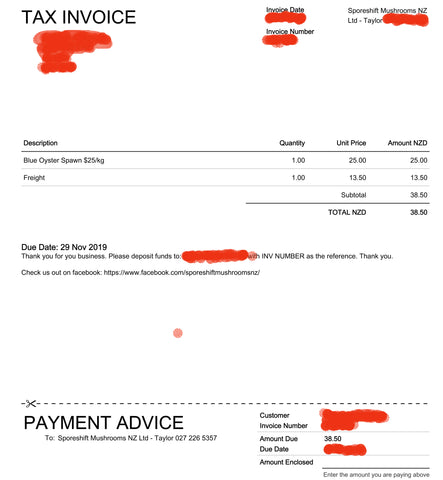
An invoice can establish the seller, buyer, date, quantity and commercial description recorded for a transaction. It can help create a chain of custody when its invoice number, packaging, batch and sample seals remain linked to laboratory material.
An invoice description such as “blue oyster spawn” does not establish a scientific name. The common name may cover different Pleurotus lineages, and an invoice cannot show whether a culture was pure, contaminated or genetically mixed.
What MPI’s blue-oyster investigation established
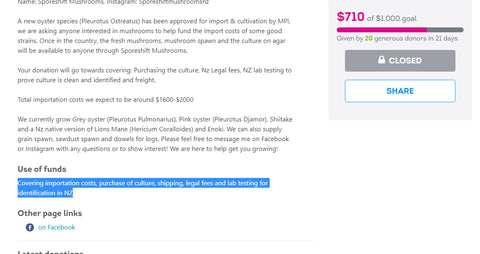
MPI reported in 2020 that spawn advertised online as Pleurotus ostreatus was acquired from an unnamed retailer. The Plant Health and Environment Laboratory identified it as an undescribed lineage then referred to as Pleurotus sp. OB within the wider P. ostreatus species complex.
Back-tracing identified four imported cultures—two hybrids and two assigned to the OB lineage—and related stock held by ten unnamed retailers. Available cultures were recalled. MPI did not publicly name the importer or retailers in that report. Read MPI Surveillance 47(2), pages 29–30.
In 2023 MPI reported another detection involving an oyster mushroom bought from an Auckland supermarket. Testing identified a hybrid between P. ostreatus and the OB lineage. Import records indicated that it probably arrived incidentally in spawn imported under a valid P. pulmonarius permit. Read MPI Surveillance 50(2).
Building a reliable chain of custody
A defensible culture-identification process connects the transaction to the material tested. Useful records include:
- the original listing, invoice and payment record;
- sealed packaging showing seller, product and batch;
- dated photographs of receipt and sample opening;
- a unique sample code maintained through transfers;
- records of storage and every person handling the sample;
- a laboratory report stating methods, sequences and reference data; and
- a retained voucher or culture accession that can be re-examined.
Without those links, even a technically sound DNA result may not establish that the tested material was the same material sold in a particular transaction.
From barcode result to species conclusion
The ITS region is the standard primary DNA barcode for fungi, but it does not resolve every species complex. A laboratory should compare high-quality sequence data with authenticated references and use additional markers when the group requires them. Morphology, provenance and voucher material provide complementary evidence.
A report returning only “Pleurotus sp.” places a culture within the genus but does not by itself show that it is new to science, imported, hybrid or unlawful. Those conclusions require additional taxonomic and regulatory evidence.
Responsibilities for sellers and buyers
Sellers can reduce uncertainty by providing an accepted scientific name, strain or batch code, culture source, and clear statements about whether identity has been independently tested. Import documentation should be retained where applicable.
Buyers should preserve labels and invoices, ask what evidence supports “native,” “hybrid” or species claims, and avoid transferring uncertain cultures under a more precise name than the evidence supports.
New Zealand regulatory considerations
EPA’s new-organism framework and MPI’s import requirements are organism-specific. MPI currently requires permits for edible mushroom cultures and spawn, scientific-name labelling, manufacturer documentation and border clearance. If a species is not eligible for import, an EPA approval and an appropriate import pathway may be required.
A local sale does not prove that all regulatory requirements were met, but it also does not prove a breach. Questions about a particular culture should be referred to MPI or EPA with the transaction and identity evidence available.
What the evidence supports
- Oak and Spore is a Canterbury grower, spawn and substrate producer, retailer and cultivation educator.
- One 2022 commercial sample attributed to Oak and Spore was independently identified as P. djamor.
- Images associated with Oak and Spore show cultivated oyster mushrooms but do not establish exact identity.
- MPI confirmed that misidentified blue-oyster cultures circulated through unnamed New Zealand retailers.
- MPI’s public reports reviewed here do not identify Oak and Spore or Tom Brain.
- Invoices and photographs need a documented chain of custody and appropriate laboratory work before they can support a species-level conclusion.