Evidence status: the scientific and public-listing sources are linked below. The named supply relationships are the author’s account and have not been independently verified with transfer records. Neither species identity nor unlawful importation can be determined from the video stills.
New mushroom genetics deserve clear scientific names, traceable provenance and an identifiable regulatory status. Sporeshift Mushrooms has promoted oyster cultures under names including Snow White, Blue and Black King while using the phrase “just landed in NZ” and highlighting the performance of the genetics in Canterbury.
That language raises reasonable questions about what these cultures actually are, where they came from and which New Zealand regulatory pathway applies to them.
Those questions are particularly important in relation to Black King. Overseas scientific literature documents a commercially cultivated mushroom known as Black Pearl King Oyster as an interspecific hybrid between Pleurotus ostreatus and Pleurotus eryngii.
That matters because MPI's present list of mushroom species eligible for import for growing includes Pleurotus ostreatus, P. pulmonarius and P. djamor, but does not include Pleurotus eryngii. MPI states that fungal species not approved for import may require new-organism approval from the Environmental Protection Authority before an import pathway can be created.
The evidence reviewed here does not by itself prove that Sporeshift's Black King is Black Pearl King Oyster, nor does a commercial name alone establish an organism's genetics. Public sales of products carrying this name make precise identification important; a shared name does not establish a shared source culture.
Video stills: what the pictures show
These are cropped screenshots of Sporeshift Mushrooms’ public reel. Its caption names Snow White, Blue and Black King. The individual frame-to-name assignments have not been verified, so the labels below describe visible features only. No picture here establishes illegality.
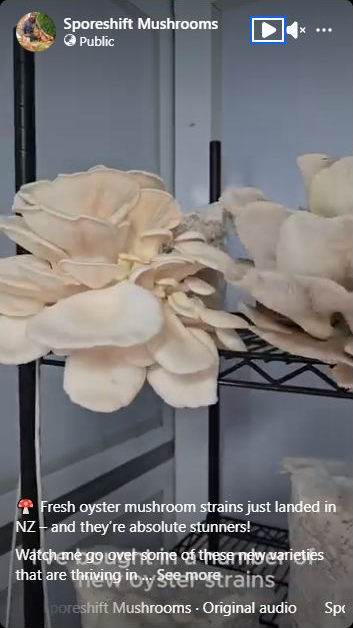
Reel time 11.75 seconds. Scientific species and hybrid ancestry are not established by this image.
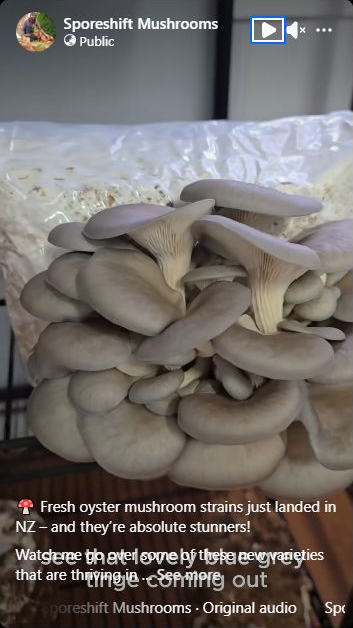
Reel time 30.86 seconds. Scientific species and hybrid ancestry are not established by this image.
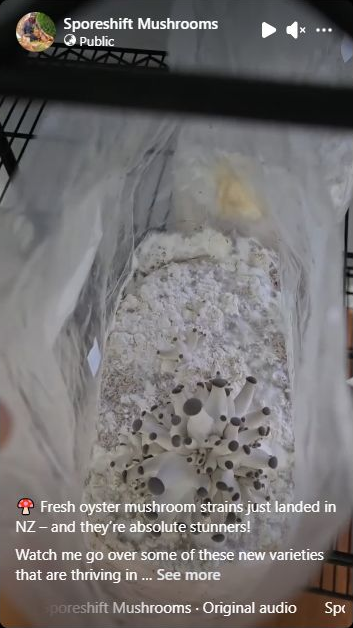
Reel time 46.12 seconds. Scientific species and hybrid ancestry are not established by this image.
| Name in the caption | Scientific identification | Relevant regulatory question |
|---|---|---|
| Snow White / Blue | Unverified for these cultures. | If a culture is an eligible species such as P. ostreatus, import conditions still apply. Colour or a trade name does not establish clearance or a breach. |
| Black King | Not established as the Black Pearl King strain described in the cited study. | P. eryngii is absent from MPI’s current fungi-for-growing eligibility list. A suspected hybrid needs its actual regulatory status checked; the image cannot establish its ancestry. |
Source images: Sporeshift Mushrooms / Facebook. Cropped to the video area, without generative editing. See the MPI and research references below.
What “just landed in NZ” actually establishes
Sporeshift's promotional wording suggests novelty and recent availability.
It does not establish:
- who originally imported the culture;
- when it entered New Zealand;
- whether Sporeshift imported it directly or obtained it domestically;
- the scientific species or hybrid designation under which it entered;
- the strain identifier;
- the MPI permit or clearance associated with it; or
- its status under the Hazardous Substances and New Organisms Act.
A mushroom newly offered by a business is not necessarily a newly imported organism.
But equally, describing genetics as newly arrived does not answer the regulatory question.
New Zealand regulates scientific organisms, not marketing names
MPI's current fungi-import guidance lists the edible mushroom species presently eligible for importation for growing.
Among Pleurotus, the current list includes:
Pleurotus djamor Pleurotus ostreatus Pleurotus pulmonarius
It does not list Pleurotus eryngii. MPI: steps to importing fungi for growing
MPI’s published testing guidance lists identification testing for all Pleurotus imports, to be done at its Plant Health and Environment Laboratory. MPI: testing requirements
That scientific-identification requirement is particularly relevant because names such as “Black King”, “Blue”, “Snow White” and “Black Pearl” are commercial names rather than regulatory taxonomic identities.
A commercial label cannot establish whether a culture is:
- ordinary P. ostreatus;
- another member of the P. ostreatus species complex;
- an interspecific hybrid;
- a hybrid involving P. eryngii; or
- another Pleurotus organism entirely.
Black Pearl King is scientifically documented as an eryngii hybrid
Relevant scientific context comes from research on a commercial strain described as Black Pearl King Oyster. The study did not examine the New Zealand cultures discussed here.
A peer-reviewed study published in Molecules describes the commercial strain used in its experiment as:
Pleurotus ostreatus × Pleurotus eryngii.
The researchers describe their experimental material as a commercial interspecific hybrid. Molecules, 2023, sections 2 and 3.1
Commercial terminology is less consistent. Overseas growers and sellers use names including Black Pearl King, Black King, Black King Oyster and similar variations.
That naming overlap does not prove that every Black King culture is Black Pearl King.
It makes scientific identification more important.
Why Pleurotus eryngii changes the regulatory question
MPI's 2024 review of mushroom-spawn eligibility distinguished species already established in New Zealand from organisms that are not known to be present here.
MPI explained that organisms not present in New Zealand may be new organisms under the HSNO Act and therefore require EPA approval before MPI can establish an import pathway.
The EPA register records a specific determination proceeding for Pleurotus eryngii under section 26 of the HSNO Act, with its decision notified on 15 December 2004. A register entry showing that a determination was made is not, by itself, permission to import this seller’s culture. EPA register S2604021
And P. eryngii is absent from MPI's present list of mushroom species approved for import for growing.
Consequently, if a culture circulating as Black King is genuinely an ostreatus × eryngii hybrid, its regulatory status cannot safely be inferred merely because P. ostreatus itself is permitted.
The hybrid needs its own scientifically and legally defensible identity.
New Zealand has already encountered this exact kind of oyster-identification problem
This is not a hypothetical concern.
During MPI's 9 January–16 February 2024 consultation on mushroom spawn, MPI disclosed that genetic testing of recently imported material labelled Pleurotus ostreatus did not match the genetic identity of older New Zealand specimens used to establish the species' existing status.
MPI said that discrepancy had prevented importation of the tested spawn.
MPI explained that commercial oyster strains may fall within the wider Pleurotus ostreatus species complex even though they differ from the narrower genetic identity represented by established New Zealand material.
That 2024 account explains why identification matters, without establishing the status of the cultures in the reel. MPI’s January–February 2024 consultation
Wainui Valley’s Black King: public products and a reported source
Other businesses publicly market Black King products. Their names alone do not establish a shared culture or supplier.
According to the author’s account, which has not been independently verified for this article, Wainui Valley Mushrooms obtained its Black King culture from Sporeshift Mushrooms.
Wainui Valley Mushrooms website
Wainui Valley is now openly selling both fresh Black King mushrooms and Black King home-growing kits. Its website describes Black King as a:
“Japanese hybrid.” Wainui Valley’s product listing
The business presently lists Black King among its fresh gourmet mushrooms and its grow-kit range.
That wording is significant.
It does not establish that the organism is Black Pearl King Oyster, but it independently confirms that Wainui Valley itself regards the culture as a hybrid, rather than simply presenting it as an ordinary P. ostreatus strain.
If that reported source relationship is confirmed, a further question is:
What exactly was supplied?
Zozo’s MiniGarden: reported distribution requires records
Another Canterbury mushroom producer relevant to the distribution picture is Zozo's MiniGarden.
Zozo's publicly operates a commercial mushroom business from the Lincoln area and sells fresh mushrooms and ready-to-fruit mushroom products. Its current website describes its ordinary fresh oyster listing as Pleurotus ostreatus. Zozo’s fresh oyster listing
The author reports that Black King mushrooms grown by Zozo's MiniGarden were supplied to the following Christchurch retailers. No invoices, labels or statements confirming these specific relationships were provided for this review:
China Town Market — Upper Riccarton. No standalone official business website was located during this review; the store is independently listed by MPI among Christchurch Asian retailers.
Sunson Asian Food Market — Upper Riccarton, with other Sunson locations operating in Christchurch. New Zealand company records list no standalone website for the Riccarton business, although Sunson maintains a public Facebook presence.
Kosco — Riccarton. Kosco website
Wang Korea Food Market Hornby — Hornby. Wang Trading / Wang Korea Food Market website
FreshChoice Merivale — Merivale. FreshChoice Merivale website
Wang Trading's own website confirms its Hornby Christchurch location at 6 Tower Street. FreshChoice independently confirms its Merivale supermarket at 189 Papanui Road.
The public websites and business records establish that these retailers exist. They do not, on their own, independently verify the specific Zozo's Black King supply relationship. Those specific distribution claims remain the author’s unverified account.
If invoices, packaging photographs, shelf photographs, delivery records or retailer labels are available, they would provide straightforward documentary confirmation.
Zozo’s MiniGarden and a reported “Rainbow Oyster” retail example
The photographer who supplied these images identifies the packs as a Zozo’s MiniGarden product displayed at FreshChoice Merivale on Papanui Road, Christchurch. The visible front labels say “Rainbow Oyster Mushroom”, with “100% NZ Grown / 0 Spray /150g”, but do not name the grower or a scientific species. The supplier connection remains the photographer’s account.
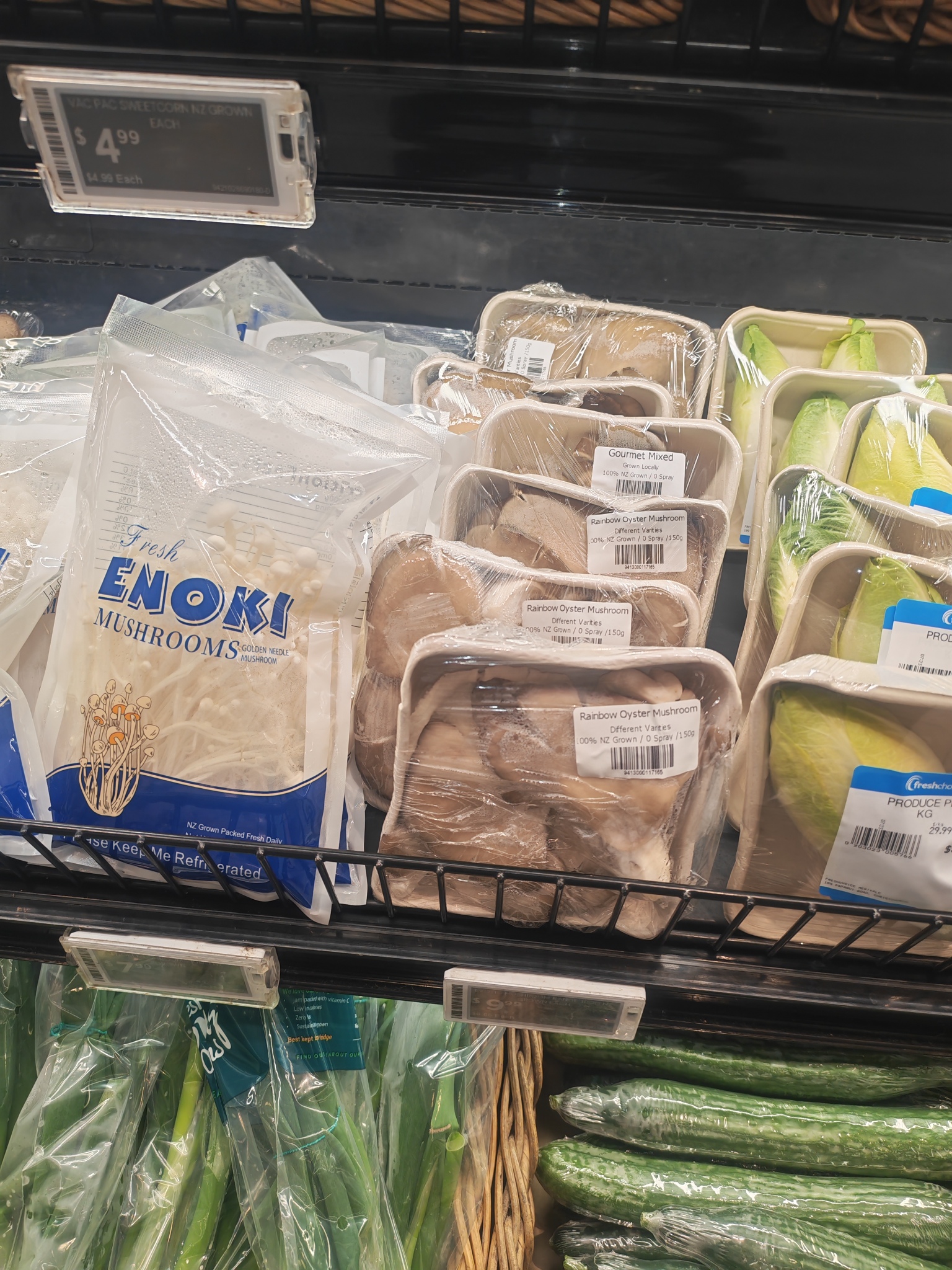
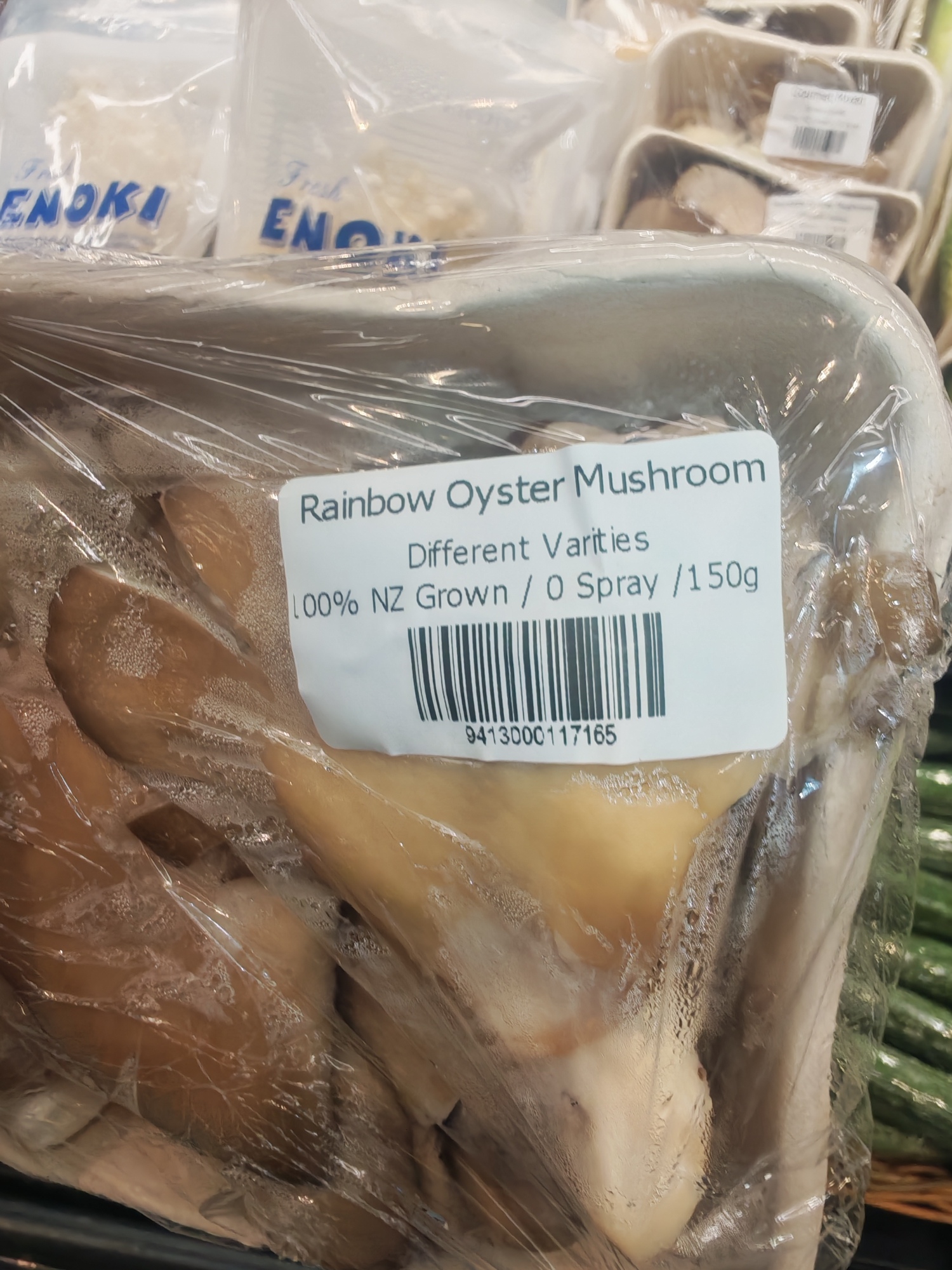
The photographer reports poor condition, discolouration and slime. The images show moisture on the film and variation in mushroom colour, but do not establish bacterial contamination or responsibility for any deterioration. The full five-photo report discusses retail quality, packaging and food waste.
For the culture-traceability question, these are photographs of a Rainbow Oyster-labelled product. They do not establish Black King identity, a link to Sporeshift’s cultures, or an unlawful import. They illustrate why a retail name needs supporting supplier and species records before it can be connected to the distribution account above.
Retail distribution greatly increases the significance of the identification question
If the reported supermarket distribution is confirmed, it would broaden the traceability question.
A culture confined to a private collection is one thing.
A culture expanded by commercial growers, fruited at production scale and distributed through numerous supermarkets is another.
If the Black King culture proves to be an ordinary legally established Pleurotus strain, documenting that identity would resolve much of the concern.
If it instead proves to be an interspecific hybrid containing P. eryngii genetics and lacking the necessary New Zealand regulatory status, then the relevant questions would extend beyond its original introduction to subsequent commercial propagation and distribution.
That is why this issue should be resolved at the source-culture level rather than farm by farm.
The retailers should not automatically be treated as responsible for the genetics
The presence of mushrooms on a supermarket shelf does not establish that the supermarket imported, cultured or even knew the genetic identity of the fungus.
Retail businesses such as China Town Market, Sunson, Kosco, Wang Korea Food Market and FreshChoice Merivale may simply be purchasing packaged fresh produce from a local supplier.
Nothing reviewed for this article establishes that those retailers participated in importing the source culture, understood its genetic provenance or were aware of any possible regulatory uncertainty.
They are listed as part of the author’s reported distribution account. The extent and existence of those specific supply relationships remain unverified; their inclusion does not establish wrongdoing.
That distinction matters.
Other commercial mushroom businesses associated with the culture network
The author also names the following businesses in an account of Black King circulation. Their participation, culture identity and sourcing have not been independently verified for this article.
They include:
Mushrooms by the Sea — Raglan Mushrooms by the Sea website
Mushrooms by the Sea is an established commercial farm with laboratory, packing and grow-room facilities and sells mushroom spawn and growing products throughout New Zealand.
The Esporium / Esporium Mushrooms — Southbridge, Canterbury The Esporium Facebook page
Contemporary reporting describes The Esporium as a Southbridge mushroom-growing business producing mushrooms from culture and spawn.
Remarkable Fungi — Queenstown Remarkable Fungi website
Remarkable Fungi publicly describes itself as a Queenstown commercial gourmet mushroom farm selling fresh mushrooms, grow kits, dried mushrooms and mushroom powders.
MycoLogic — Dunedin MycoLogic website
MycoLogic supplies mushroom spawn, grow kits and cultivation information.
Interestingly, MycoLogic's own educational material stresses New Zealand's strict biosecurity restrictions, warns that some overseas mushroom species are not available here, and advises growers not to attempt overseas culture imports outside the appropriate legal pathways. Its published list of commonly cultivated New Zealand mushrooms does not presently list Black King.
The links identify the businesses discussed in the author’s account.
It does not independently establish from their websites that each business currently possesses Black King, that each obtained it from Sporeshift, or that all cultures bearing that name are genetically identical.
Those individual supply relationships therefore require provenance records if they are to be conclusively mapped.
Research across suppliers does not establish a transfer network
A University of Canterbury research thesis provides broader sampling context. Uniformity is a myth
Commercial Pleurotus samples examined in New Zealand included material originating from Sporeshift Mushrooms, Mushrooms by the Sea, Remarkable Fungi and MycoLogic, among numerous other commercial growers.
That research does not identify those samples as Black King.
Its relevance is more general: the study sampled material from multiple suppliers. Its supplier list does not establish transfers between those suppliers, and does not verify a Black King distribution network.
A culture can spread far beyond the business that first supplied it
Living mushroom cultures are fundamentally different from ordinary manufactured goods.
Mycelium can be expanded repeatedly.
One culture can produce grain spawn. That spawn can inoculate hundreds of fruiting blocks. A grower can then retain tissue cultures, clone fruiting bodies or expand further spawn.
Grow kits distribute living mycelium directly to members of the public.
Consequently, once a culture enters a commercial mushroom network, it can rapidly develop multiple generations of downstream holders.
Those downstream growers may know very little about the culture's original import history.
A grower receiving something labelled “Black King” from an established New Zealand supplier may reasonably assume that the supplier has already established its identity and regulatory status.
That assumption is precisely why traceability at the original culture level matters.
Widespread cultivation does not prove regulatory legitimacy
There is an important logical trap here.
If ten growers possess the same culture, that does not prove that the culture was lawfully introduced.
If supermarkets sell the resulting mushrooms, that does not establish its scientific identity.
And if a culture has circulated domestically for several years, that does not by itself establish that the organism was present in New Zealand before the HSNO cut-off or received subsequent new-organism approval.
Popularity is not provenance.
Distribution is not identification.
And commercial availability is not regulatory approval.
The reverse is also true: widespread possession does not by itself prove illegality.
The decisive evidence is still the scientific identity and regulatory history of the source organism.
The reported network needs verification
The author proposes the following supply-chain outline. It is an unverified account, not a documented map of transfers:
Reported source: Sporeshift — not independently verified
↓
Wainui Valley Mushrooms
↓
fresh mushrooms and home grow kits
and, according to the author’s unverified account:
other commercial mushroom growers
including Zozo's MiniGarden, Mushrooms by the Sea, The Esporium, Remarkable Fungi and MycoLogic
↓
commercial mushroom production
↓
in the case of Zozo's supply chain, retail distribution reportedly including China Town Market, Sunson, Kosco, Wang Korea Food Market and FreshChoice Merivale.
The precise relationships between all of those businesses should be established through invoices, culture records, spawn orders, photographs, strain records or statements from the businesses concerned.
Whether or not these reported transfers are confirmed, the central identification question remains:
What is the scientific identity of the original Black King culture?
The question can be answered objectively
There is no need to settle this through accusation or speculation.
The questions for Sporeshift and any relevant suppliers are:
- the scientific name assigned to its Black King culture;
- its strain or accession number;
- whether it is Black Pearl King Oyster;
- whether it is an ostreatus × eryngii hybrid;
- whether it contains any P. eryngii ancestry;
- the supplier from which the original culture was obtained;
- whether that source was inside or outside New Zealand;
- the date the culture entered its collection;
- where importation occurred, the scientific identity under which MPI cleared it;
- the applicable import permit or border-clearance pathway;
- any EPA determination or approval relevant to the hybrid; and
- the businesses to which that culture or spawn derived from it was subsequently supplied.
For an established commercial culture, these should not be extraordinary questions.
They are basic traceability questions.
The environmental claim should also remain evidence-based
The potential biosecurity issue should not be exaggerated.
The available evidence does not establish that Sporeshift's Black King is presently invasive in New Zealand.
Nor does the fact that one parent species of Black Pearl King would be P. eryngii automatically demonstrate that the hybrid will behave ecologically in the same manner.
The stronger and scientifically defensible concern is that an organism involving genetics from a species not on New Zealand's approved mushroom-import list should have its identity and regulatory status established before unrestricted propagation and distribution are treated as routine.
That is precisely the purpose of new-organism and biosecurity controls.
Sporeshift’s published sourcing position
Sporeshift’s own article, updated in July 2023, said its cultures were sourced within New Zealand from established stocks and described contact with MPI. This earlier general statement is relevant context, but does not independently document the cultures in the reel. Sporeshift’s statement
The conclusion the evidence supports
Several points can now be separated clearly.
First, Black Pearl King Oyster is scientifically documented overseas as an Pleurotus ostreatus × Pleurotus eryngii hybrid.
Second, Pleurotus eryngii is not on MPI's current list of mushroom species eligible for import into New Zealand for growing.
Third, New Zealand regulators have already encountered substantial difficulties distinguishing commercial oyster genetics from the Pleurotus material legally established here.
Fourth, Wainui Valley is openly selling Black King fresh mushrooms and grow kits and describes the organism as a “Japanese hybrid.” According to the author’s account, which has not been independently verified for this article, its Black King culture originated from Sporeshift.
Fifth, the author reports further cultivation and retail distribution, including through Zozo’s MiniGarden. These particular relationships remain unverified and are not established by the linked business websites.
The verified product listings and scientific context warrant questions about identification. The separate supply-chain claims require supporting records before they can be treated as facts.
They do not yet prove that every Black King culture currently circulating in New Zealand is Black Pearl King, nor that every business possessing Black King is knowingly cultivating an organism without the required approval.
That missing scientific identification is exactly the problem.
If Sporeshift's Black King is an ordinary legally established Pleurotus ostreatus culture, producing its strain identity and provenance should substantially resolve the issue.
If it is instead the internationally documented Black Pearl King P. ostreatus × P. eryngii hybrid—or another novel hybrid containing P. eryngii genetics—then its EPA status, MPI pathway and subsequent commercial distribution require a considerably more detailed explanation.
Where cultures are multiplied and sold, commercial names should be accompanied by precise scientific identification and traceable sourcing.
The central question is straightforward: what exactly is New Zealand's Black King culture, where did the original culture come from, and under what regulatory status is it being propagated and distributed?
Until those questions are answered with traceable records and scientific identification, the responsible description is not that illegality has been proven.
It is that the reviewed public material does not resolve the scientific identity and regulatory position of the cultures sold under this name.
Research and commentary, 15 May 2026. This review draws on publicly available MPI and EPA records, scientific literature, business websites and an author-supplied account of distribution. No supporting transfer records were supplied for that account during this review. The websites cited establish the public activities of the businesses concerned but do not necessarily independently establish every culture transfer or wholesale relationship described above. No laboratory sample from the Black King cultures discussed here was examined for this article. Businesses named as downstream growers or retailers should not be taken as having knowingly breached biosecurity law merely because they possessed or sold material supplied to them.