Did Sporeshift Mushrooms Make an Illegal Claim to Google?
The available records do not establish that Sporeshift or Taylor McConnell made a false or unlawful claim to Google. They also do not establish that MPI bought its tested blue-oyster spawn from Sporeshift. Here is what can—and cannot—be verified.
Sporeshift’s mushroom practice
Sporeshift Mushrooms NZ is a North Canterbury business founded by Taylor McConnell with Susan Jacobs. Public profiles describe a business that began supplying gourmet mushrooms to restaurants, markets and shops, then expanded into grow kits, grain spawn, agar cultures, cultivation supplies and education.
Sporeshift says it produces spawn and undertakes culture work for home growers and other small mushroom farms. Its educational material covers grow kits, log cultivation, outdoor beds and grain spawn. A 2024 Canterbury Horticultural Society talk described the business growing oyster mushrooms, shiitake, tawaka and pekepeke-kiore and supporting growers who supply local markets and restaurants. View Sporeshift’s summary of the talk.
The allegation about Google
In 2021, a page on this site concerning Sporeshift ceased appearing in Google Search. It was alleged that Taylor McConnell or Sporeshift denied selling the culture and supplied false information to Google to obtain the removal.
No copy of the removal request, Google decision, court order or correspondence reviewed for this article establishes who made a request, which Google policy or law was invoked, what representations were made, or why the result stopped appearing. Without those records, it is not possible to establish that Sporeshift made the request, that any statement was false, or that any law was broken.
The word “illegal” requires more than disagreement about facts. It would require the actual statement, the circumstances in which it was submitted and the law said to have been breached. None of those elements is established by a missing search result.
Online visibility and scientific evidence are different
| Record | What it can establish | What it cannot establish alone |
|---|---|---|
| Google search result | A URL was indexed and displayed at a particular time | Whether every claim on the page was true |
| Removal notice | The requester, ground and scope if those details are disclosed | The taxonomic identity of a culture |
| Product listing or invoice | The name used, seller, date and quantity | Species, ancestry, purity or import history |
| Photograph | Visible form, label and context | Exact species or hybrid parentage |
| Laboratory report | Results for the sample actually tested | Connection to a sale without chain of custody |
| MPI or EPA decision | The official finding and regulatory scope stated in that record | Facts about unnamed parties beyond the record |
Did MPI buy the spawn from Sporeshift on Trade Me?
MPI’s 2020 report says an incursion investigator acquired blue-oyster spawn advertised online as Pleurotus ostreatus from “a retailer.” The report does not name the retailer, the website or marketplace, the notifier, or the supplier. It therefore confirms an official purchase and investigation, but it does not publicly confirm a purchase from Sporeshift on Trade Me.
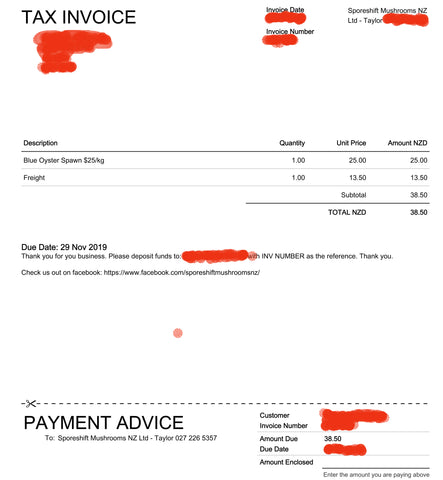
A separate redacted invoice image held by this site names Sporeshift Mushrooms NZ Ltd and describes one kilogram of “Blue Oyster Spawn,” invoiced in November 2019. That image supports the narrower statement that Sporeshift issued an invoice for a product sold under that common name. The customer and invoice number are redacted, and the image has no MPI case number, sample seal, laboratory identifier or other link to the material tested by MPI.
Independent research involving Sporeshift cultures
A University of Canterbury thesis examining cultivated Pleurotus in New Zealand records three commercial samples attributed to Sporeshift Mushrooms, Christchurch, collected in February 2022:
- Pleurotus djamor: voucher DH568, DNA identifier DH1425, PDD 124113.
- Pleurotus parsonsiae: voucher DH566, DNA identifier DH1422, PDD 124109.
- Pleurotus pulmonarius: voucher DH561, DNA identifier DH1299, PDD 124111.
These records provide independent evidence about the three samples studied. They do not identify every culture Sporeshift supplied, establish the identity of a product sold under a different name, or retrospectively answer what material the business possessed in 2019 or 2020. View the University of Canterbury thesis record.
What MPI found in the tested blue-oyster culture
MPI reported in 2020 that it acquired spawn advertised as Pleurotus ostreatus from an unnamed online retailer. Laboratory work identified the material as an undescribed lineage then referred to as Pleurotus sp. OB within the wider P. ostreatus species complex.
MPI traced related stock through a supply network, found four imported cultures that included two hybrids and two cultures assigned to the OB lineage, and recalled available cultures held by ten unnamed retailers. The report records a positive biosecurity investigation involving misidentified material; it does not record a conviction or identify the businesses involved. Read MPI Surveillance 47(2), pages 29–30.
MPI described another detection in 2023 involving an oyster mushroom bought from an Auckland supermarket. Testing identified a hybrid between P. ostreatus and the OB lineage. Again, the public report did not identify Sporeshift. Read MPI Surveillance 50(2).
How a claim about a supplier should be verified
Before connecting a named supplier to a regulatory investigation, a publisher should seek records that join each step:
- a dated listing or offer from the supplier;
- an invoice and payment record;
- sealed packaging and a batch or culture identifier;
- a documented chain of custody from receipt to testing;
- a complete laboratory report and retained voucher;
- an official MPI or EPA record connecting that material to the regulatory finding; and
- a fair opportunity for the named supplier to provide records or correct factual errors.
Where those links are absent, the accurate formulation is that the connection has not been independently established.
Correcting mushroom information online
A knowledge resource should correct the source page when evidence changes, rather than relying on whether a search engine displays it. A useful correction identifies the precise claim, links the new source, explains what changed and preserves the date of the revision.
For disputed culture identities, corrections should separate:
- the commercial name used at the time;
- the later laboratory identification;
- the identity of the sample actually tested;
- the official regulatory response; and
- any remaining uncertainty about other batches or cultures.
New Zealand regulatory considerations
MPI requires edible mushroom cultures and spawn to follow the applicable import-health pathway, including a permit, scientific-name labelling, manufacturer documentation and border clearance. EPA approval may be needed where a viable organism meets the statutory definition of a new organism.
Neither a seller’s claim nor an online accusation determines legal status. For a particular culture, current MPI requirements, EPA decisions and the evidence linking the tested organism to the material in question are decisive.
What the evidence supports
- Sporeshift is a North Canterbury grower, culture and spawn producer, retailer and cultivation educator founded by Taylor McConnell with Susan Jacobs.
- Independent university research records three commercial Pleurotus samples attributed to Sporeshift and identifies them as P. djamor, P. parsonsiae and P. pulmonarius.
- MPI confirmed that misidentified blue-oyster cultures circulated through unnamed New Zealand retailers.
- MPI’s public reports reviewed here do not identify Sporeshift or Taylor McConnell.
- No Google request or decision record reviewed here establishes that Sporeshift submitted false information or made an unlawful claim.
- A redacted invoice supports that Sporeshift invoiced “Blue Oyster Spawn,” but it does not connect that transaction to MPI’s tested sample.
- A search-result removal does not establish the truth or falsity of a mushroom-identification claim.
References
- Sporeshift: founder talk and cultivation activities
- RNZ/ODT profile: Sporeshift grow kits and farm history
- University of Canterbury: Uniformity is a myth
- MPI Surveillance 47(2), 2020
- MPI Surveillance 50(2), 2023
- Google: Requests to remove content
- EPA: About new organisms
- MPI: Steps to importing fungi for growing