Was Sporeshift Mushrooms NZ Caught Selling Illegal Mushroom Spawn?
A Sporeshift invoice and a Trade Me screenshot document blue-oyster spawn offered under the name Pleurotus ostreatus. MPI separately confirmed that misidentified blue-oyster cultures circulated through unnamed retailers. Do the records establish that these were the same spawn?
Claim examined
Sporeshift sold blue-oyster spawn on Trade Me, and MPI later identified that spawn as an unapproved, undescribed Pleurotus lineage.
Sporeshift’s New Zealand mushroom practice
Sporeshift Mushrooms NZ is a North Canterbury business founded by Taylor McConnell with Susan Jacobs. It began as a gourmet mushroom farm supplying restaurants, markets and shops and expanded into grow kits, grain spawn, agar cultures, cultivation supplies and education.
The business says it produces spawn, undertakes culture work and supports home growers and other small farms. Its public educational work covers indoor kits, outdoor logs, garden beds and larger-scale grain-spawn cultivation. Read Sporeshift’s description of its activities.
The 2019 fundraiser
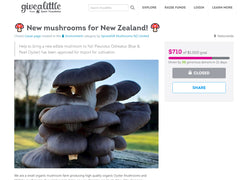
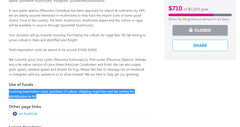
A Givealittle campaign sought funding for new mushroom cultures for New Zealand. The page discussed purchasing a culture, shipping, legal fees and laboratory testing for identification in New Zealand. It shows that the organiser recognised that importation and identification could involve formal costs.
The campaign does not establish that the proposed import occurred, that any culture entered New Zealand, or that a later blue-oyster product came from the culture pictured on the page.
The spawn photograph
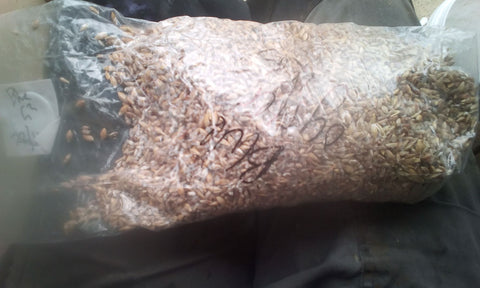
The photograph shows a partly colonised bag of grain with handwriting on the plastic. It may document the condition of a product at a particular time, but colonisation percentage, shipping cost and appearance cannot answer the taxonomic or legal question.
The Sporeshift invoice
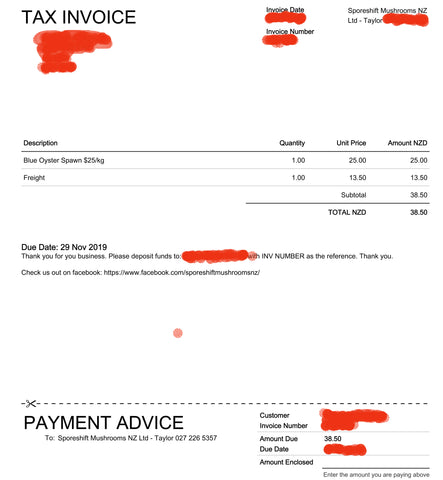
The invoice identifies Sporeshift as seller and records one kilogram of “Blue Oyster Spawn,” plus freight. It is relevant primary evidence that Sporeshift sold a product under that common name.
The customer, invoice number and other details are redacted. The invoice does not provide a scientific culture identifier, batch, MPI case number, test result or retained voucher. It cannot by itself establish that the product was Pleurotus sp. OB or that its sale breached a law.
The Trade Me listing
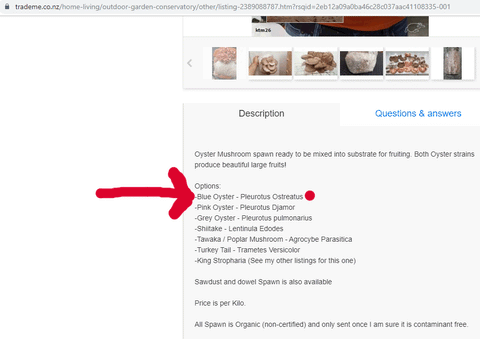
The listing is evidence that a seller used the scientific name P. ostreatus for a blue-oyster option. In the cropped image, the seller identity and date are not visible. Even with a seller identified, the listing would establish the advertised name rather than the organism’s laboratory identity.
What MPI’s 2020 investigation established
MPI reported that an incursion investigator acquired spawn advertised online as P. ostreatus from an unnamed retailer. The Plant Health and Environment Laboratory identified it as an undescribed lineage then called Pleurotus sp. OB, which was distinct from the true P. ostreatus material used in an earlier EPA determination.
MPI also investigated four cultures imported by another unnamed retailer. Testing found two hybrids and two cultures assigned to the OB lineage. Back-tracing found related stock at ten unnamed retailers, and available cultures were recalled.
Read MPI Surveillance 47(2), pages 29–30.
Can the transaction and MPI sample be connected?
| Evidence | What it establishes | Missing link |
|---|---|---|
| Sporeshift invoice | A sale described as one kilogram of “Blue Oyster Spawn” | No culture code, batch, case number or test result |
| Trade Me screenshot | A listing described blue oyster as P. ostreatus | Seller and date are not visible in the crop |
| Spawn photograph | The appearance of a bag represented as the supplied spawn | No sealed sample or laboratory chain of custody |
| MPI report | An unnamed retailer’s spawn was identified as Pleurotus sp. OB | No public retailer, transaction or sample identifier |
A direct connection would require records such as an unredacted transaction supplied under proper authority, sealed packaging, matching identifiers, MPI evidence-receipt documentation or an official statement naming the supplier. Those records have not been located for this article.
Independent research involving Sporeshift
A University of Canterbury thesis records three commercial samples attributed to Sporeshift and collected in February 2022. They were identified as P. djamor (PDD 124113), P. parsonsiae (PDD 124109) and P. pulmonarius (PDD 124111).
These records independently document those three later samples. They do not identify the 2019 blue-oyster product and should not be used either to prove or disprove the identity of that earlier spawn. View the University of Canterbury thesis record.
Was the spawn “illegal”?
The common name “blue oyster” is not a legal classification. True P. ostreatus was determined by EPA in 2019 to have been present in New Zealand before the HSNO Act cut-off date. MPI later explained that some commercial cultures sold under that name fall elsewhere within the broader P. ostreatus species complex and do not match true P. ostreatus.
A culture’s status depends on its actual identity, whether it is a new organism, its import pathway and any approvals or clearance applying to it. An undescribed lineage may require regulatory attention, but the word “undescribed” does not alone establish a criminal offence by a seller.
MPI said the biological risk of the OB lineage was initially unclear, then used an existing P. ostreatus assessment to conclude that it would not pose a biosecurity risk. The report therefore does not support predictions that this culture would devastate native forests or endanger consumers.
MPI’s report supports saying that misidentified, previously unrecorded cultures entered a New Zealand supply chain and were recalled. It does not support saying, without the missing supplier link, that Sporeshift was officially caught or found guilty of selling an illegal organism.
What the evidence supports
- Sporeshift is a North Canterbury mushroom grower, culture and spawn producer, retailer and educator associated with Taylor McConnell and Susan Jacobs.
- A redacted invoice documents a Sporeshift sale described as one kilogram of “Blue Oyster Spawn.”
- A Trade Me screenshot advertised a blue-oyster option as P. ostreatus, although the visible crop does not identify the seller.
- MPI identified spawn from an unnamed retailer as Pleurotus sp. OB and recalled related cultures from an unnamed supply chain.
- MPI’s public report does not identify Sporeshift, Taylor McConnell or Trade Me.
- The available records do not connect the Sporeshift transaction to MPI’s tested sample.
- No public enforcement decision reviewed here finds Sporeshift or Taylor McConnell guilty of an offence concerning this spawn.