Pleurotus purpureo-olivaceus in New Zealand: Identification and Cultivation
This dark violet-brown oyster mushroom is an important part of Aotearoa’s indigenous fungal diversity. It can grow abundantly on decaying wood, yet producing reliable fruiting bodies under controlled cultivation remains an unsolved challenge.
What is Pleurotus purpureo-olivaceus?
Pleurotus purpureo-olivaceus is a wood-decaying oyster mushroom recorded from New Zealand forests. It has also been called the olive oyster, although that common name is used for unrelated mushrooms overseas and should never be treated as a scientific identification.
The current name dates from a 1995 revision by Barbara Segedin, Peter Buchanan and John Wilkie. Older New Zealand material was placed under names including Resupinatus purpureo-olivaceus, Pleurotus rattenburyi and, in part, P. ostreatus. That history helps explain why older records and labels do not always use today’s preferred name.
Identification
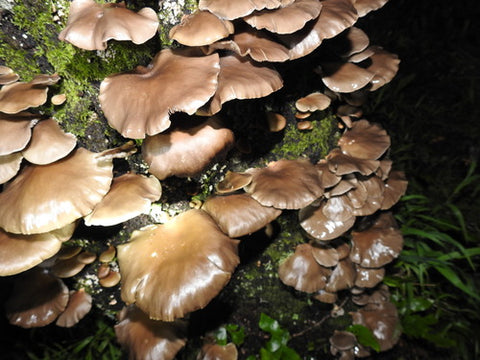
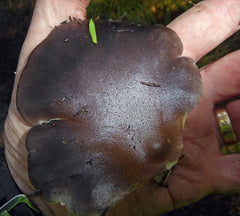
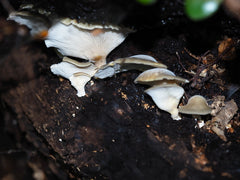
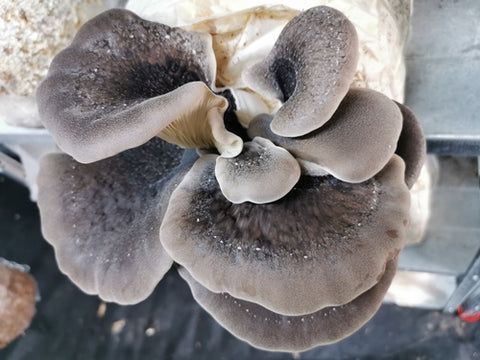
The formal New Zealand description gives a combination of macroscopic and microscopic characters. A typical fruit body has a broadly spoon-shaped or fan-shaped cap, usually 10–70 mm across. The surface can be dark violet, brownish violet or olive-brown and has been described as smooth, moist and rubbery rather than slimy.
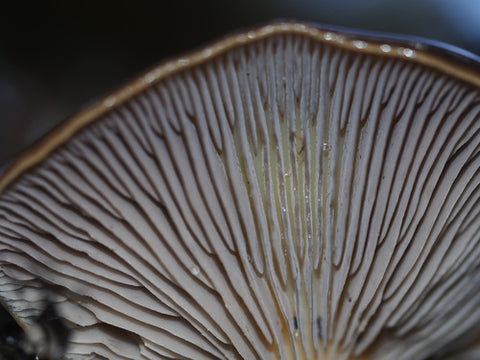
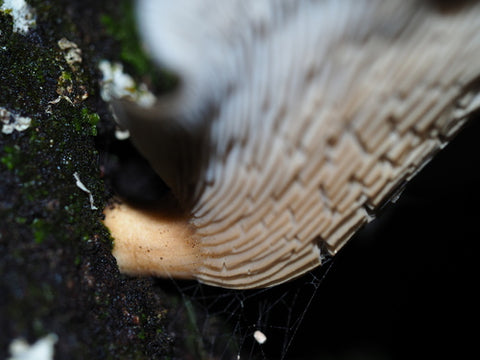
The gills run down the short lateral stem. In documented material they are pale silvery grey, thin and crowded. The stem is generally 5–15 mm long, grey-lilac with possible yellowish tones near its base. The spore print is white.
Microscopic characters matter
The 1995 description reports smooth, thin-walled, non-amyloid spores measuring about 6.5–9 × 4.5–5 μm. It also describes crowded cheilocystidia on the gill edge and distinctive dark, banded or incrusted hyphae in the cap surface. Those details require microscopy and experience to assess.
Recent New Zealand research used five gene regions as well as morphology. This is a useful warning against treating an image, common name or a single uncurated DNA database match as conclusive.
| Possible identification | Useful differences | Why care is needed |
|---|---|---|
| P. purpureo-olivaceus | Often dark violet-brown; rubbery cap; pale grey crowded gills; short lateral stem; white spore print. | Age, moisture, lighting and strain variation can change the visible colour. |
| P. australis | Can also be brown and oyster-shaped, but documented material usually lacks the same rubbery texture and grey-gill combination. | The two should not be treated as close equivalents. The 2026 phylogeny places them in different parts of the genus. |
| Hohenbuehelia species | Some have similarly dark, lateral fruit bodies. A gelatinous layer under the cap surface and large metuloid cystidia are important microscopic clues. | These features are easily missed in photographs and weathered specimens. |
| Other pleurotoid fungi | Crepidotus, Panellus, Conchomyces and related forms can share the shelf-like habit. | Spore colour, tissue structure and microscopy may be needed to reach genus level. |
Ecology and distribution
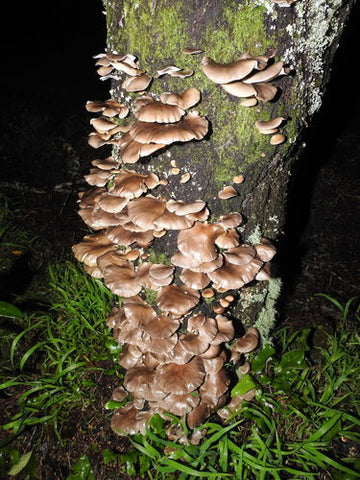
Collection records place this fungus mainly on dead or decaying wood, especially southern beech in the former Nothofagus grouping, now including Fuscospora and Lophozonia. Records also include old elder stumps and other woody substrates. It can form dense overlapping groups on fallen logs or standing dead material.
The species is widespread in New Zealand records, with material from both main islands. The 2026 study treats it as one of the country’s indigenous Pleurotus lineages. Manaaki Whenua’s current Biota of New Zealand record, however, lists its origin status as uncertain and notes possible material from Australia and South Korea with morphological or phylogenetic differences.
The most defensible description is therefore indigenous to New Zealand and also supported by genetic evidence from Australia. Calling it strictly endemic—that is, naturally found nowhere else—goes beyond the current evidence.
Taxonomy, genetic work and living cultures
A 2026 peer-reviewed study analysed 84 wild and cultivated New Zealand Pleurotus specimens using ITS, LSU, RPB1, RPB2 and Tef markers alongside morphology. It confirmed P. purpureo-olivaceus as a distinct lineage, found no evidence for the previously reported asexual or anamorphic state, and placed it outside the subgenus Coremiopleurotus. P. australis, by comparison, retains a documented asexual state.
The International Collection of Microorganisms from Plants holds multiple living cultures under this name. Manaaki Whenua’s current record displays cultures including ICMP 9630, 11569, 11570, 17077 and 20713, among others. Their existence demonstrates that the fungus was isolated and preserved well before recent commercial interest.
A collection accession is valuable because it connects living material to a stable identifier. It does not automatically prove that an unrelated culture carrying the same species name is genetically identical. Growers and researchers should preserve the supplier, strain code, voucher, isolation location and any sequence data together.
What cultivation evidence actually exists?
Reliable fruiting is still unresolved. A 2024 University of Canterbury doctoral study tested a large set of New Zealand Pleurotus cultures under controlled conditions. The experimental process successfully maintained P. purpureo-olivaceus mycelium, produced grain spawn and colonised prepared substrate, but none of the tested strains produced fruit bodies during the 78-day experiment.
| Stage tested | Conditions used in the study | What happened |
|---|---|---|
| Agar and spawn | PDA cultures and rye grain were incubated at 27°C; grain spawn was held for roughly 2–3 weeks. | Viable mycelial material could be produced. This establishes culture growth, not fruiting success. |
| Substrate colonisation | Sterilised Pinus radiata sawdust pellets at about 65% water content were inoculated and incubated at 27°C and about 93% relative humidity. | The species grew vegetatively on prepared substrate, although its substrate mass loss was low relative to the successfully fruiting study species. |
| Fruiting phase | The room was changed to 18°C, about 92% relative humidity, frequent fresh-air exchange and a ten-hour blue-light period. | No tested P. purpureo-olivaceus strain fruited before the experiment ended. |
| Pilot approaches | Cold shocks and different temperature and humidity settings were also tried. | These adjustments did not induce fruiting. |
These conditions are a record of an unsuccessful experiment, not a recommended recipe. They do disprove a simple assumption that this fungus can be treated like a standard commercial oyster and expected to fruit merely by lowering temperature and adding humidity.
The earlier observation that some cultures appear slow is worth measuring, but slow laboratory growth does not prove that straw is universally unsuitable. Substrate preference, strain effects, wood chemistry, microbial partners, seasonal signals and fruiting triggers all remain plausible research questions.
How to approach experimental growing work
Because a dependable method has not been established, a careful grow should be treated as a documented experiment rather than a promised crop.
- Start with authenticated material. Use a culture with a stable strain or accession number and retain its provenance. Do not clone a photographically identified wild mushroom and assume its name is settled.
- Separate colonisation from fruiting. Record plate growth, spawn run and substrate colonisation independently. Fast white growth does not show that a culture will make mushrooms.
- Use replicated treatments. Compare several strains and multiple bags for each condition. A single successful or failed block cannot establish a species-wide rule.
- Test substrate chemistry deliberately. Compare standard clean sawdust with legally sourced host-associated hardwood material. Keep moisture, supplementation and sterilisation consistent within each treatment.
- Measure the environment. Log temperature, relative humidity, carbon dioxide, light period and fresh-air exchange rather than relying on room descriptions.
- Change one factor at a time. Seasonal temperature cycles, humidity, host chemistry and microbial partners are all candidates, but changing everything together makes the result difficult to interpret.
- Voucher a success. Photograph each stage, preserve a dried fruit body and link it to the living culture and grow record. Consider depositing scientifically useful material with an appropriate collection.
Dowel inoculation into logs is a reasonable experimental format for a wood-decay fungus, but no controlled source reviewed here demonstrates a reliable log or dowel method for this species. A product listing or colonised plug should not be treated as proof that fruiting will occur.
Collection, permissions and biosecurity
- Obtain the landowner’s permission before taking fruit bodies, wood or cultures from private land.
- DOC permission is required for research or collection of fungi on public conservation land. Commercial use can involve additional requirements.
- Take only the small amount needed for identification or culture work and avoid damaging the host log or surrounding habitat.
- Keep precise locality data and consult mana whenua where collection, research or commercial development may engage cultural interests.
- Do not order viable cultures from overseas without checking the current MPI import pathway. A New Zealand species name on a foreign culture does not bypass import controls.
- If a culture or fruit body appears to be an unusual organism not normally seen in New Zealand, photograph it, prevent further distribution and report it to MPI.
What the evidence currently establishes
- P. purpureo-olivaceus is a distinct oyster mushroom present in New Zealand and treated as indigenous by current peer-reviewed research.
- Evidence from Australia means strict New Zealand endemism should not be stated as settled fact.
- The species is associated especially with decaying southern-beech wood, but recorded substrates are broader than one host.
- Macroscopic features can support an identification; microscopy, voucher material and multi-gene data provide stronger evidence.
- Living cultures are preserved in recognised scientific collections.
- Recent controlled work produced vegetative growth but no fruit bodies, so there is not yet a validated commercial cultivation protocol.
- Claims of exceptional flavour, yield, historic firsts or guaranteed performance require evidence that is not supplied by a field photograph or a culture label.
Related reading
- Pink Oyster Mushrooms in New Zealand
- Mushroom culture identity and provenance in New Zealand
- Pleurotus species in New Zealand
References
- Manaaki Whenua, Biota of New Zealand: Pleurotus purpureo-olivaceus
- Hera et al. (2026): multi-gene phylogeny and morphology of Pleurotus in Aotearoa New Zealand
- Hera (2024), Uniformity is a myth: doctoral thesis repository record
- Hera (2024): full thesis, including cultivation methods and results
- Grey et al. (2021): cultured New Zealand fungi, including P. purpureo-olivaceus
- Manaaki Whenua: International Collection of Microorganisms from Plants
- Department of Conservation: research and collection permits
- MPI: steps to importing fungi for growing
- MPI: report an unusual pest or disease
The photographs on this page were retained from the site’s own image collection. Their files contain no visible photographer credit or linked voucher record. They are therefore presented as field illustrations and not as verified taxonomic specimens.