New Zealand fungi and wildlife
North Island Robin Eating an Oyster Mushroom: What the Observation Shows
Photographs of a toutouwai beside a pale oyster-shaped fungus became a useful record of bird–fungus interaction in Aotearoa. A published account confirms repeated pecking at the fruit body, while modern taxonomy changes how confidently the fungus itself should be named.
What does the record establish?
The record does not establish the bird's total intake, nutritional benefit or whether viable fungal spores were later dispersed. Those are separate questions requiring closer observation or experimental work.
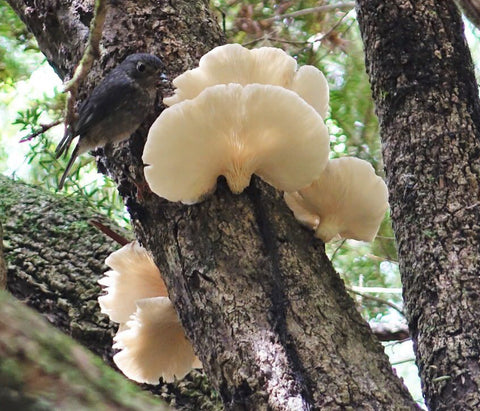
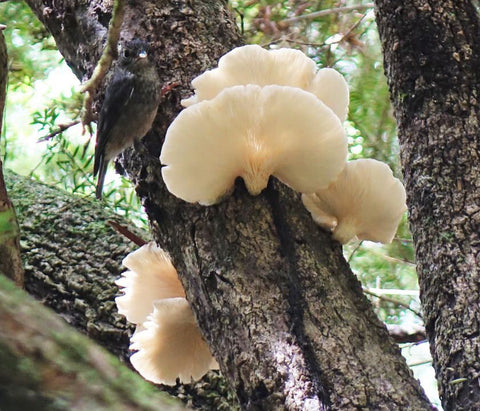
The Matuku Link observation
Jacqui Geux photographed the bird in original native forest at Matuku Link, West Auckland, on 6 January 2018. The fungus was growing from a decaying cabbage tree or tī kōuka (Cordyline australis). The account published in Birds New Zealand states that the edge of the fungus was visibly serrated where the robin had pecked it.
The observation later became part of a small but growing record of fungal feeding by New Zealand birds. Geux had also photographed a North Island robin extracting a truffle-like fungus from the ground in 2014, beating it against a root and apparently eating part of it. Earlier literature recorded a robin feeding from decaying Armillaria limonea fruit bodies.
What do North Island robins usually eat?
The North Island robin or toutouwai, Petroica longipes, is endemic to Aotearoa and forages extensively on or near the forest floor. DOC describes its diet as mainly invertebrates, ranging from tiny aphids to large prey such as earthworms, stick insects and tree wētā. Small fruit supplements the diet in late summer and autumn when dry conditions reduce soil-dwelling prey.
Robins inspect litter, bark, logs and other structures where prey may hide. In a 1976–78 study of South Island robins at Kowhai Bush, birds broke up agaric mushrooms to reach small invertebrates living in them. That behaviour makes hidden prey a plausible alternative here, but it is not evidence of what this North Island bird swallowed.
Which oyster fungus was it?
The public iNaturalist record is currently graded “Needs ID” and identifies the fungus only to the genus Pleurotus. The 2018 Birds New Zealand account reported the fruiting as P. opuntiae, but that name has a complicated history here. Manaaki Whenua's current Biota of New Zealand record marks New Zealand use of P. opuntiae as recorded in error and explains that local material placed under that name belongs within the P. djamor species complex, which includes P. parsonsiae.
Historical New Zealand descriptions of “P. opuntiae” often involved pale fruit bodies on dead cabbage trees, so the reported name was understandable under the taxonomy then in use. A photograph, host tree and cap colour are still insufficient for a modern species determination. A retained specimen plus microscopic and, where necessary, molecular evidence would normally be needed to update the identification confidently.
| Question | What the evidence supports | What remains unresolved |
|---|---|---|
| Which bird? | North Island robin/toutouwai, Petroica longipes | The public account describes an unbanded female, so no individual history is available. |
| What behaviour? | Repeated pecking of small pieces from the fungal cap edge | The quantity swallowed and any invertebrate prey taken at the same time |
| Which fungus? | A pale, wood-growing Pleurotus, reported in 2018 as P. opuntiae | A current species-level identification without a traceable voucher and modern analysis |
| Ecological result? | A documented bird–fungus foraging interaction | What was swallowed, its nutritional importance and whether the bird dispersed viable spores |
Oyster fungi are food and habitat
A mushroom is a temporary feeding site for more than vertebrates. Fungus-gnat larvae and other small invertebrates can live in or around fruit bodies and fungal mycelium. A mushroom can therefore be potential food in its own right and a place where an insect-eating bird may find prey. This general ecology does not prove that the photographed fruiting contained gnats, springtails or any other prey.
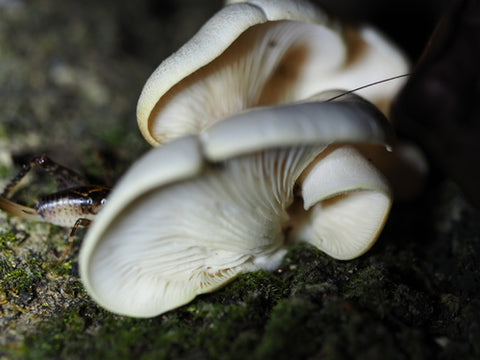
The earlier suggestion that Pleurotus attracts insects because the fungus captures nematodes mixes separate ecological processes. Some Pleurotus mycelia can immobilise nematodes, while fungus-associated insects use fruit bodies and mycelium for their own feeding or development. Neither fact proves that a robin visiting a cap was responding to a chemical lure.
Why this observation matters
Fungal feeding by birds has historically been under-recorded. Diet studies often identify seeds, bones and insect fragments more readily than digested fungal tissue. Recent New Zealand research has strengthened the wider case that birds interact with and may disperse some fungi, especially colourful truffle-like species whose spores are enclosed inside the fruit body.
The Matuku Link record concerns an exposed, gilled mushroom whose spores normally disperse through the air. It adds credible evidence that a surviving native bird directly interacts with a mushroom fruit body, but it does not show that the bird is an effective disperser of this Pleurotus. Small body size, short gut-retention times and a limited home range may also constrain the distance a robin could move ingested spores. Demonstrating dispersal would require evidence that spores were ingested, transported and deposited alive in a place where they could germinate.
How to document a similar interaction
- Record a short video or a sequence showing the bird before, during and after contact with the fungus.
- Note whether it removes fungal tissue, extracts a visible invertebrate, swallows material or carries it away.
- Photograph the whole fruiting, cap surface, gills, attachment and substrate without disturbing the bird.
- Record date, location, host tree or wood type, weather and how long the behaviour continued.
- Upload linked bird and fungus observations to iNaturalist NZ — Mātaki Taiao and include the behavioural notes.
- Only collect a fungal voucher where permission, conservation rules and land access allow it; record the observation even when collection is inappropriate.
Do not feed or handle wildlife to obtain a photograph. Natural behaviour, accurately documented, is the useful evidence.
Related reading
- Oyster mushrooms in New Zealand: species, cultivation and biosecurity
- Pleurotus purpureo-olivaceus: identification and cultivation
- Split-gill mushroom in New Zealand
References
- iNaturalist NZ observation 9380399: North Island robin feeding from a fungus
- Birds New Zealand, June 2018: “North Island Robin eats fungus”, Jacqui Geux and John Sumich
- Department of Conservation: North Island robin/toutouwai
- New Zealand Birds Online: North Island robin
- Biota of New Zealand: Pleurotus opuntiae name record and New Zealand status note
- Powlesland (1981): foraging behaviour of the South Island robin
- Jakovlev (2012): fungal hosts and ecology of fungus gnats
- Beever & Lebel (2014): truffle characteristics and bird dispersal in New Zealand
- Brunton-Martin, Wood & Gaskett (2024): evidence for adaptation of colourful truffle-like fungi for birds in Aotearoa New Zealand
- Boast et al. (2025): fungal DNA and spores in moa coprolites
- iNaturalist NZ: Jacqui Geux's citizen-science contribution and CC BY photo licensing
The two robin photographs are credited to Jacqui Geux and linked to their iNaturalist record. The third photograph is retained for subject context but should not be published until its creator and reuse licence are confirmed.