Split-gill Mushroom in New Zealand: Identification, Edibility and Respiratory Risk
Schizophyllum commune is a small, tough wood-decaying mushroom found throughout New Zealand. Its divided gill edges are remarkable, and it is eaten in several tropical food traditions. It can also cause uncommon but serious respiratory disease, so “edible” is not a complete safety description.
A central North Island observation
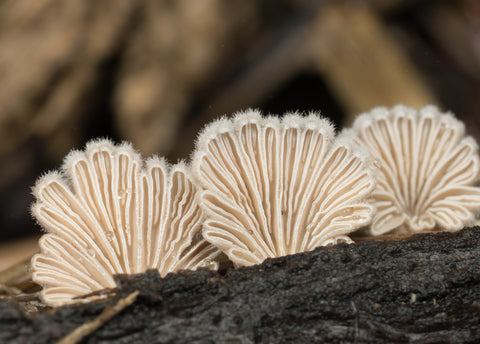
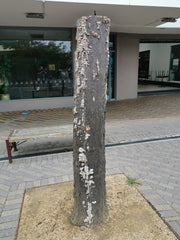
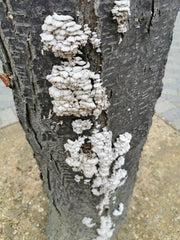
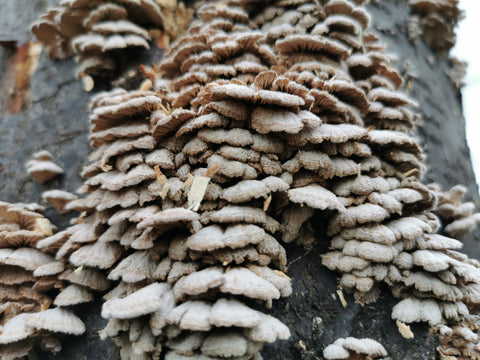
Three site photographs document dense, overlapping shelf fungi on a cut urban tree in a central North Island shopping area. A separate close view in the site's image collection shows the fan-like fruit bodies and radiating folds associated with split-gill. No retained voucher specimen, microscopic record or DNA result accompanies the photographs, so they should be treated as a probable field identification rather than a verified scientific collection.
How to recognise split-gill
Schizophyllum commune produces thin, leathery fruit bodies attached directly to wood. They are usually fan- or shell-shaped, often only a few centimetres across, with a grey-white to fawn upper surface covered in fine hairs. The underside carries radiating folds that resemble gills.
The common name comes from the lengthwise groove or split along each gill edge. The paired edges curl according to moisture conditions, helping the fruit body survive drying and resume activity when humidity returns. New Zealand descriptions record a white spore print and narrowly oblong to cylindrical, smooth, colourless spores.
| Feature | What to look for | Limit |
|---|---|---|
| Substrate | Dead wood, stumps, logging debris and wounded woody plants | Many unrelated bracket fungi use the same substrate. |
| Upper surface | Small, thin, tough, hairy and grey-white to fawn | Colour changes with age, moisture and exposure. |
| Underside | Radiating folds with edges split lengthwise | A clear underside view is essential; distant photographs are inadequate. |
| Attachment | Usually lateral and without a true central stem | Growth form varies when fruit bodies are crowded. |
| Confirmation | Microscopy, a retained specimen and expert review; DNA when needed | Do not base eating or culture work on image matching alone. |
Its status in New Zealand
Biota of New Zealand records S. commune as present, common across the country and found on indigenous and introduced trees and shrubs. Its origin status is listed as uncertain, with a note that it is often associated with introduced hosts and disturbed habitats. It has been recorded in New Zealand since at least the nineteenth century.
A 2013 New Zealand study compared local material with three broad global genetic groups. All sampled New Zealand sequences fell in the European–Asian–Australian group. The authors found no evidence that the sampled North/Central American or South American groups had naturalised here and concluded that the observed local diversity could be explained by two pre-human dispersal events.
Is split-gill edible?
There is strong ethnomycological evidence that S. commune is collected and eaten in parts of tropical Mexico, north-eastern India and Southeast Asia. A study of two Lacandon communities in Chiapas described it as the most widely recognised and consumed mushroom among participants, while also noting its tough texture. Thai food research continues to study split-gill extracts and cultivated fruit bodies as food ingredients.
That evidence supports the statement that split-gill has genuine food traditions. It does not make every New Zealand collection suitable to eat. Regional knowledge includes identification, harvesting and preparation practices that a short web description cannot replace. The word “edible” also says nothing about contamination, host wood, individual allergy or the respiratory risk from living cultures and spores.
An Indonesian recipe page previously linked by this site gives one example of split-gill being stir-fried with chilli, garlic and other ingredients. It is useful as culinary context, not as an identification or medical source. The third-party watermarked food photograph has not been reproduced on this revised page because its reuse licence could not be established.
What the medical evidence actually says
S. commune is an environmental wood-rotting fungus and an uncommon human pathogen. Medical reports associate it mainly with the respiratory tract: allergic bronchopulmonary mycosis, sinusitis, bronchial mucus impaction and fungal balls. Rare invasive disease has also been reported.
A 2013 review counted 71 reported cases at that time; 94% involved bronchopulmonary disease or sinusitis. Later reports include disease in both immunocompromised and apparently immunocompetent patients. The small number of published cases, together with improved laboratory identification, makes it difficult to estimate the true incidence. These reports establish a real hazard but do not show that ordinary outdoor encounters usually cause illness.
A 2016 New Zealand news report described a fatal disseminated infection in a 35-year-old Wellington woman, with disease reported in her lungs, brain and heart. That case should be described as a rare clinical infection, not shortened to “death from spores.” A news account does not establish the exact exposure event, dose or route, and one severe case cannot be used to predict the risk of a casual sighting outdoors.
Practical exposure precautions
- Do not deliberately inhale spores or handle a heavily sporulating culture close to your face.
- Avoid brushing, sanding or disturbing heavily colonised dry wood in an enclosed space without suitable respiratory and dust controls.
- People with asthma, chronic sinus or lung disease, or impaired immunity should seek medical advice before cultivating a prolific sporulating fungus indoors.
- Persistent wheeze, cough, sinus symptoms or other illness requires clinical assessment; a webpage cannot diagnose fungal allergy or infection.
- Do not treat or self-medicate a suspected fungal infection using mushroom products.
Cultivation: possible, but not a casual indoor project
Split-gill is cultivated and studied as a food fungus in parts of Thailand and elsewhere in tropical Asia. Research has used hardwood sawdust-based substrates with agricultural supplements, and recent work continues to compare substrates, strains, yield and food properties. Those systems use selected cultures and managed production conditions; they do not validate an unknown wild collection for indoor fruiting.
The main question for a New Zealand grower is not whether the mycelium can colonise wood. It is whether the culture is correctly identified and traceable, whether introducing or distributing that strain is lawful, and whether the fruiting space controls spores and protects occupants. For a household, especially one with respiratory vulnerability, an enclosed living area is a poor place to test an unknown split-gill culture.
Biosecurity, wood health and collection
Split-gill usually behaves as a saprobe on dead wood, but New Zealand records also describe it entering wounded trees and contributing to heart rot or cankers. Fruit bodies on an urban stump are evidence of fungal activity in the wood; they do not, by themselves, show why the tree was cut or prove that split-gill killed it.
Do not import cultures or inoculated material because the species name occurs in New Zealand. An overseas strain may represent a different population, and all viable fungal imports remain subject to New Zealand’s biosecurity rules. If an organism or culture appears unusual or has an uncertain import history, contain it and ask MPI rather than releasing or selling it.
Collect only with the landholder’s permission. DOC states that collecting fungi from public conservation land requires authorisation. Photographs, notes about the wood and location, and a carefully retained voucher are more valuable for identification than removing every fruit body.
What the evidence supports
- Schizophyllum commune is widespread and well recorded in New Zealand, but its formal origin status here remains uncertain.
- The split edges of its gill-like folds are a strong field character; a photograph alone is still insufficient for an eating decision.
- It has established food traditions in several tropical regions and a tough texture that limits its appeal elsewhere.
- It is an uncommon but documented cause of allergic, colonising and invasive disease, predominantly involving the respiratory tract.
- A rare fatal infection does not justify calling every outdoor fruiting a threat, and traditional food use does not erase occupational or cultivation exposure questions.
- New Zealand culture work should consider strain provenance, biosecurity and spore exposure as well as cultivation performance.
Related reading
- Pleurotus purpureo-olivaceus in New Zealand
- Mushroom culture identity and provenance in New Zealand
- Pleurotus in New Zealand
References
- Biota of New Zealand: Schizophyllum commune
- Fuller, Johnston & Pearson (2013): non-native split-gill strains and New Zealand biosecurity
- Chowdhary et al. (2013): S. commune as an emerging fungal pathogen
- Cavanna et al. (2019): human infections and literature review
- Emerging Infectious Diseases: etymology and clinical context
- Ruan-Soto et al. (2009): traditional mushroom use in Lacandon communities, Chiapas
- Sensory study of split-gill mushroom extract in Thai food systems
- Cultivation and growth of split-gill mushroom on agricultural substrates in Thailand
- Indonesian split-gill recipe example: Dentist vs Chef
- Stuff: 2016 Wellington clinical case report
- DOC: research and collection authorisations
- MPI: report an unusual organism
Food and health information on this page is general education. Mushroom identification and medical diagnosis require appropriate local expertise.