New Zealand fungi and cultivation
Tūwāka (Cyclocybe parasitica): Growing a Mushroom That Can Rot Living Trees
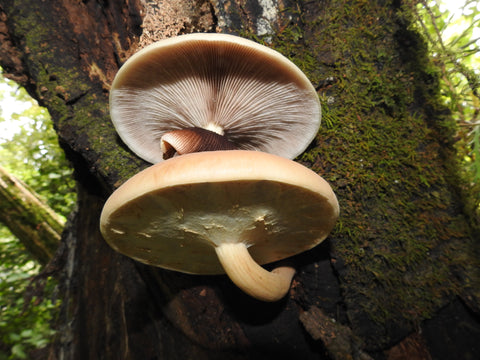
Tūwāka is a remarkable edible fungus found on both native and introduced broadleaf trees. Its association with heart rot makes the choice of growing site and material more consequential than it is for many familiar substrate-grown mushrooms.
Should you grow tūwāka?
There is no basis for claiming that every tree bearing tūwāka has been given a “death sentence”. Heart rot can develop slowly, and the fruit body alone does not reveal the extent of decay or the likely outcome for the tree. Nor does finding fruit bodies on a nearby poplar prove that a person growing mushrooms introduced the fungus. The tree may have been colonised earlier by spores from the surrounding environment.
Name, origin and similar mushrooms
The accepted name in the Biota of New Zealand database is Cyclocybe parasitica; Agrocybe parasitica is an earlier combination. Tawaka or tūwāka is a Māori name. Biota records the species as present in New Zealand but lists its origin as uncertain, noting a possible early introduction from Asia. Calling every local culture definitively native would go further than that record supports.
The cultivated “poplar mushroom” name can also refer to Cyclocybe cylindracea, a different species. MPI's mushroom spawn consultation describes C. cylindracea as not present in New Zealand. A common name on a culture label is therefore insufficient to establish species identity or import status.
What does the fungus do to a tree?
New Zealand forestry references describe C. parasitica as a hardwood heart-rot fungus; some records also report invasion of sapwood. It has been recorded on a broad range of native and introduced hosts, including tawa, kohekohe, lacebark, poplar and other deciduous trees. The mycelium lives within wood, while the mushroom is its visible fruiting body.
A fruiting on a trunk signals that fungal growth is already established in the wood. It does not establish that the tree will soon die. Tree age, wound history, remaining sound wood and any other stress all matter. A tree with decay can also supply habitat for insects and birds, so management depends on where the tree stands and what it might strike if a branch or trunk fails.
A careful approach to cultivation
- Confirm the culture. Keep its source and identification records. Do not assume that “poplar mushroom” identifies C. parasitica.
- Keep living trees out of the experiment. Deliberate inoculation of a live trunk would expose that tree to a wood-decaying fungus.
- Choose the site with neighbouring trees in mind. Where a project may fruit outdoors, consider the host trees around it and seek local expert advice if the risk matters.
- Contain and dispose of spent material thoughtfully. Do not leave colonised wood beside standing trees or move it into bush or other properties without permission.
- Check the rules for imported material. MPI's rules for importing fungal cultures and spawn are distinct from the question of whether a species is already recorded in New Zealand.
These precautions are a risk-based approach to cultivation. They do not establish that every outdoor tūwāka project will infect adjacent trees.
What if tūwāka appears on an existing tree?
Photograph the cap, gills, stalk, point of attachment and whole tree; note the host species and location. Confirm the mushroom's identity before acting on it. If the tree is near a house, road, path or play area, ask a qualified arborist to assess its structure. Removing the visible mushrooms does not remove mycelium already inside the tree.
Food and cultural context
Tawaka has a documented history as a Māori food. Manaaki Whenua's Ngā Rauropi Whakaoranga records gathering in summer and steaming or stone-boiling it. That history is more substantial than a claim that it should be eaten merely to “save” trees. Picking fruit bodies is not a treatment for internal heart rot.
Do not eat a mushroom identified only from a web page or this photograph. Confirm an individual collection with someone competent in New Zealand fungi and follow any land-access or collection rules.
Related reading
- Oyster mushrooms in New Zealand: species and biosecurity
- Pleurotus purpureo-olivaceus: identification and cultivation
- A North Island robin and an oyster mushroom
Sources
- Biota of New Zealand: Cyclocybe parasitica, taxonomy, status, hosts and descriptions
- New Zealand Farm Forestry Association: tree decay fungi of native and introduced trees
- Ngā Rauropi Whakaoranga: tawaka and its recorded food uses
- MPI: mushroom spawn species and the distinction between C. parasitica and C. cylindracea
- Royal Horticultural Society: interpreting heartwood fungi on living trees