Learn · Culture work
Agar and Mushroom Culture Basics: Plates, Transfers and Clean Growth
Agar gives mushroom mycelium a visible surface to grow across. Learn how to handle plates, compare growth and build a documented culture before making liquid culture or grain spawn.
Observe growth and maintain small working cultures on a solid nutrient medium.
Transfer a small piece of suitable mycelium without introducing unwanted microbes.
A plate's appearance does not establish species identity or guarantee crop performance.
What an agar plate is
Agar is a gelling material obtained from certain seaweeds. In culture work, it holds a nutrient medium in a solid form inside a plate or other suitable vessel. The nutrients support fungal growth; the agar creates a surface on which that growth can be observed.
A mushroom culture is living mycelium established on the medium. An unused agar plate is only prepared medium. Plates are useful for maintaining a working culture, starting a tissue culture, checking a liquid culture sample and preparing inoculum for grain. They are small culture tools rather than fruiting substrates.
Understand MEA, PDA and SDA
Culture media differ in nutrient composition and sometimes pH. Follow a formulation or handling instruction suited to your mushroom culture, rather than assuming all plates are interchangeable.
| Medium | What the name means | Practical point |
|---|---|---|
| MEA | Malt extract agar | A fungal culture medium containing malt-derived nutrients; formulations vary. |
| PDA | Potato dextrose agar | A widely used medium based on potato nutrients and dextrose. |
| SDA | Sabouraud dextrose agar | A medium used for fungi and yeasts; composition and modifications should be checked. |
For a first experiment, use one documented medium and a known culture. Antibiotics or stronger nutrient concentrations should not be treated as substitutes for clean handling.
Prepare the plates and workspace
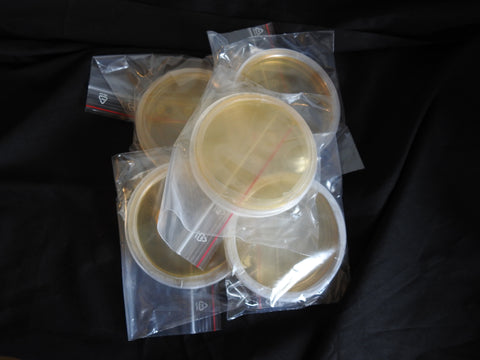
Check unopened plates for unexpected colonies, damage, excessive drying or a compromised closure. Follow their storage instructions. Making your own plates adds separate steps: accurate preparation, an appropriate sterilisation process and clean dispensing. Do not copy a treatment time from a different vessel or load.
Arrange a clean transfer area with the source culture, destination plates, sterile tools, suitable plate wrap and labels. A still-air transfer chamber can reduce dust movement; a properly operated laminar-flow workstation provides controlled clean air. A kitchen surface that has been wiped down is not sterile.
Use sterile disposable transfer tools or an appropriate sterilisation procedure for reusable tools. Keep alcohol and other flammable disinfectants away from ignition sources.
Make a simple agar-to-agar transfer
Practise with an established edible mushroom culture before attempting to isolate growth from an unknown sample. Set up everything first so open plates spend as little time exposed as possible.
- Label the destination plate's base with the culture code, date, medium and parent plate.
- Inspect the source plate through its lid. Select a small area of actively growing mycelium with the expected appearance.
- Using a sterile, cool tool, remove a small piece of colonised agar.
- Briefly lift the receiving lid, place the piece on its medium and close the plate.
- Secure the closure and put the plate in the culture's recommended incubation conditions.
- Record growth and any unexpected colonies without reopening the plate for routine inspection.
A tool that has been heat-sterilised must cool before contacting live mycelium. Avoid transferring exhausted central material when suitable newer growth is available.
Work with tissue, grain or liquid culture
Fresh inner tissue from a confidently identified edible mushroom can be placed on agar to attempt a tissue culture. Expose the inner tissue without dragging a dirty outer surface across it, then transfer a tiny piece with a sterile tool. The starting tissue can still carry contamination, so observe the first growth and make a suitable follow-up transfer before expanding it.
A colonised grain or a small liquid culture sample can also be placed on agar to examine what grows. This is useful for screening a culture before committing a large grain batch. Keep different samples on separately labelled plates.
These tests provide information about the tested sample under the chosen conditions. One apparently clean plate does not prove that an entire liquid culture vessel or spawn bag is free of contaminants.
Observe growth and contamination
Check plates regularly through the closed lid. Note where growth began, how it spreads and whether it resembles the expected culture. Appearance can change with medium, age and temperature. Rope-like, fluffy or fast growth is not by itself a guarantee of a productive mushroom strain.
Separate colonies, spreading wet or slimy areas and unfamiliar coloured or powdery growth can indicate unwanted organisms. White growth is not automatically the desired mushroom. Do not identify a contaminant or mushroom species from colour alone.
For beginners, keep suspect plates closed and remove them from the working collection. Do not reopen sporulating mould plates in the culture area. A clean replacement culture is usually a more reliable starting point than repeated attempts to rescue a badly contaminated sample.
Retain an uninoculated plate from the same batch as a control. Contamination there can help flag a medium or handling problem.
Seal and store appropriately
Plate wrapping helps keep the lid in place and reduces accidental opening. Parafilm-type laboratory film is gas-permeable; it is not a sterilisation treatment. Use a closure compatible with the vessel and culture, and inspect it for damage. Do not assume any household tape has the same properties.
Incubation and storage are separate stages. Follow species- and strain-specific guidance for each. Some cultures tolerate refrigeration, while others are damaged by it. An ordinary freezer is not equivalent to controlled cryopreservation and can injure living agar cultures. Watch for drying and arrange fresh working cultures before a plate is exhausted.
Keep records and choose the next step
Give each culture a unique code and connect its transfers to a documented parent. Record the species identification, source, medium, date, conditions and observations. Photograph the closed plate when comparing growth between batches. A transfer count is useful history, rather than a score for culture quality.
Keep identity, apparent purity and growing performance as separate questions. Species identification may require specialist examination or DNA work; a clean-looking culture cannot answer that question alone. Productivity must be assessed in an appropriate fruiting trial.
Once a working culture shows suitable growth without visible contamination, it can supply inoculum for a small grain or liquid culture batch. Expand gradually and check the new batch before using it more widely.