Substrates and preparation
Hardwood and Soy Hull Substrate: A Master’s Mix Guide
Hardwood supplies the main structure and carbon source; soy hulls add nutrients. This combination can support vigorous growth of wood-loving mushrooms, but its richer recipe also makes careful preparation and clean inoculation more important.
What is in “Master’s Mix”?
“Master’s Mix” usually means a supplemented hardwood substrate containing hardwood sawdust or pellets and soy hulls. Equal amounts by dry weight are a common starting formulation, although growers may adjust the ratio for their species, equipment and contamination pressure. Soy hulls are not the same as soy flour or soybean meal. Substituting another ingredient changes the nutrients and the preparation method.
The mix is often used for oyster mushrooms and other wood-loving cultivated fungi. It is not automatically the best substrate for every species or strain. A simple hardwood block or pasteurised straw may be easier for a beginner to manage because they are less heavily supplemented.
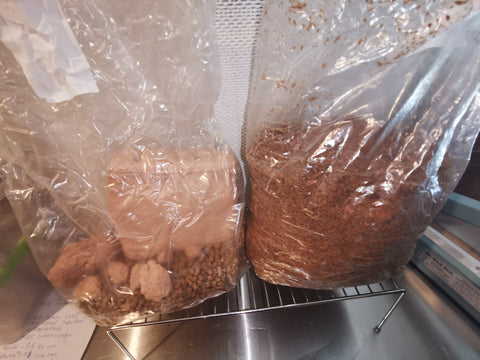
Preparing a supplemented block
- Identify the ingredients and bag. Confirm the dry weights, the wood source and whether the bag is designed for heat treatment. Avoid treated timber, painted wood and unknown pellet additives.
- Hydrate the full mix. Add clean water in measured increments and mix it through. Check for even hydration rather than a dry centre or a pool at the base.
- Use a suitable treatment. A soy-hull-supplemented hardwood block generally needs a validated sterilisation process after hydration, using equipment that can heat the entire block adequately. Pasteurising straw and sterilising supplemented sawdust are different processes.
- Cool before inoculating. Keep the treated material closed as directed and let its centre reach room temperature. Warm substrate can damage spawn.
- Inoculate cleanly. Use healthy, identified spawn and an appropriate aseptic transfer setup, such as a correctly operated clean-air workstation or suitable still-air workspace, with sterile transfer tools and minimal exposure of the opening. A wiped bench alone does not create sterile conditions. Close the bag while leaving its designed filter patch unobstructed for gas exchange.
How much water belongs in a bag?
There is no reliable universal number of litres. Water demand depends on the dry mass, pellet composition, added nutrients and target moisture. Measure the dry ingredients and the water, then use a tested recipe for that formulation. The substrate should be thoroughly hydrated without free liquid collecting at the bottom. If a prepared bag has its own instructions, follow its specified ratio instead of copying a quantity from an unrelated bag.
A grower's notes should record dry weights, water added, treatment, inoculation date, culture identity and results. That makes it possible to adjust the next batch rather than guessing why one block performed differently.
From spawn to a colonised block
Spawn is mycelium already growing on a carrier such as grain or sawdust. Mix a suitable amount through cooled, treated substrate using a method appropriate for the bag and culture. More spawn may speed colonisation, but it does not guarantee more mushrooms and can add cost or moisture. Conversely, a very low spawn rate leaves the substrate uncolonised for longer. Use a tested ratio for the exact formulation.
During incubation, inspect through the film for spreading mycelium, unexpected colours and wet breakdown. White growth alone does not confirm purity. Do not open a suspect container for a close smell test. The centre of an actively growing block may run warmer than the room; a hot-water cupboard can overheat it. Light alone is not a reliable reason for a block failing to colonise. Species, culture vigour, substrate treatment, moisture and temperature are more useful things to check.
Fruiting and troubleshooting
Once the block is well colonised or begins to pin, make a small opening where a cluster can emerge. Provide suitable humidity, indirect light and fresh air for the identified species. Do not assume that more slits always mean more total yield: too many openings can dry the block. Harvest oyster clusters before the cap edges turn strongly upward and before heavy spore release.
- Green or black mould, sour odour or slime: isolate the bag from other cultures and do not eat mushrooms from a clearly spoiled block.
- Water pooling: review the hydration calculation and drainage before repeating the recipe.
- Long stems and small caps: increase fresh-air exchange during fruiting while maintaining humidity.
- Slow, uneven white growth: check whether the block was too hot, too wet, under-treated or inoculated with weak spawn.
For the complete sequence from separate substrate and spawn bags to harvest, see the two-step oyster mushroom growing bag guide.
New Zealand context
Use a culture whose scientific identity and provenance you can document. “Oyster mushroom” describes several Pleurotus species; it does not establish that a strain is native to New Zealand. MPI sets requirements for importing living fungal cultures and spawn, so check current rules before obtaining material from overseas. For local growing, choose untreated hardwood material and keep records of suppliers, batches and any laboratory identification.
Related reading
- Two-step oyster mushroom growing bag guide
- Ready-to-grow oyster mushroom bag guide
- Oyster mushrooms in New Zealand: species and biosecurity