Mushroom species · New Zealand
New Zealand Shiitake: Lentinula novae-zelandiae
New Zealand shiitake belongs to its own named Lentinula lineage. Its woodland ecology and authenticated culture records provide a sound starting point for learning how to grow it.
Lentinula novae-zelandiae
Present; endemic
Wood-decaying forest fungus
Use a traceable culture and record the conditions of each trial
A New Zealand species with a precise name
Lentinula novae-zelandiae is a wood-inhabiting fungus recorded as endemic to New Zealand. It is sometimes called New Zealand shiitake or bush shiitake. The familiar cultivated shiitake, Lentinula edodes, is a different named species. Using the complete scientific name helps prevent the two from being confused in growing records.
The same New Zealand fungus appears in taxonomic literature as Crinipellis novae-zelandiae and Collybia novae-zelandiae. These names reflect changes in its classification. Lentinellus novae-zelandiae, despite its similar spelling, is a different fungus.
Recognition and woodland habitat
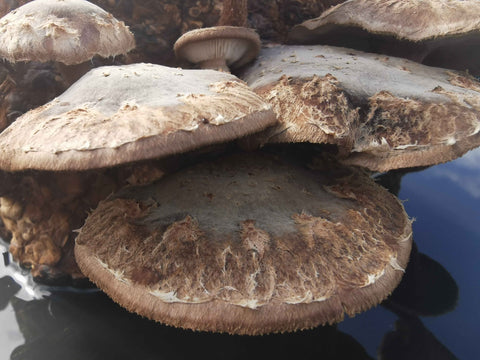
Published descriptions include dark brown to reddish brown caps, pale gills, and a stem carrying darker fibrous scales. A white spore print is another recorded character. Photographs should show the underside and the whole stem as well as the cap; a brown cap alone is insufficient for identification.
New Zealand collections document this species on wood associated with tawa and native beeches. These records describe where particular mushrooms were found. They do not establish that every listed tree is equally suitable for cultivation, or that a given wood will produce a predictable harvest.
What a documented culture establishes
An authenticated research culture, ICMP 18003, has been used to produce a chromosome-scale genome for this species and to compare it with L. edodes. That establishes a documented example of laboratory growth and genetic research. A laboratory culture growing on agar is a different result from a productive fruiting block.
The research does not provide a universal household growing schedule. A temperature used to prepare mycelium for DNA extraction should not be presented as the optimum incubation or fruiting temperature. Similarly, a genome published for one collection does not authenticate every culture carrying the same species label.
Approaching cultivation without borrowed assumptions
Start with a culture whose identity, collection history and handling records are available. Ask for evidence tied to that culture: what substrate was used, whether mushrooms actually formed, and which conditions were measured. A report of successful fruiting is more useful when it includes photographs, dates and batch details.
Use the log-growing guide to understand inoculation and the management of log moisture. For prepared substrates, use the hardwood substrate guide to understand ingredients and preparation. Neither general guide establishes a validated recipe for this particular species.
Keep a small comparison trial. Record the wood identity, particle size, dry ingredient weights, water added, treatment method, inoculation date and culture code. Note room conditions and how the substrate looks over time. Change one variable between otherwise comparable batches, rather than changing the wood, supplement and environment together.
Distinguish colonisation, primordia formation and harvest in the results. A fully colonised bag is useful progress, but it does not prove that a treatment reliably produces mushrooms. Record failed and contaminated batches as well as successful ones.
Provenance and responsible growing in New Zealand
Keep separate labels and records for L. novae-zelandiae and L. edodes. Relatedness alone does not establish that growing one will destroy wild populations of the other. Assess claims about hybridisation or ecological harm against evidence of the process, exposure and effects in the environment.
A species occurring locally does not automatically authorise bringing a culture across the border. Imported growing material must meet MPI requirements, and EPA approval is needed where the organism is legally new to New Zealand. Resolve the identity and requirements before arranging an import.